

What Is an Opportunity Analysis?

Most agents come to your home with a price.
We come with a strategy.
There’s a difference, and it matters more than most families realize until they’re already in the middle of a decision that can’t easily be undone.
A traditional CMA (Comparative Market Analysis) tells you what similar homes have sold for recently and what your home might be worth today.
That’s useful information, but it only answers one question:
What is my home worth right now?
At Team Ray & Co., we’re asking a different question:
What is the best way to maximize what you actually walk away with?
Those are not the same question.
Every Home Has Multiple Paths
Here’s what most families don’t realize when they start thinking about selling.
There isn’t one right way to bring a home to market. There are several. Most come down to a single tradeoff:
Time versus money.
Sell as-is for speed and convenience
Invest time and targeted improvements to increase sale price
Take a hybrid approach with strategic updates
What we’ve found consistently is this:
More time, used correctly, can mean more money.
But only when it’s invested in the right places. If it’s not, it becomes wasted time and wasted cost.
That’s exactly where the Opportunity Analysis comes in.
What Makes Our Approach Different
Most real estate professionals can estimate value.
We go further because we combine real estate strategy with construction-level insight.
That combination changes everything.
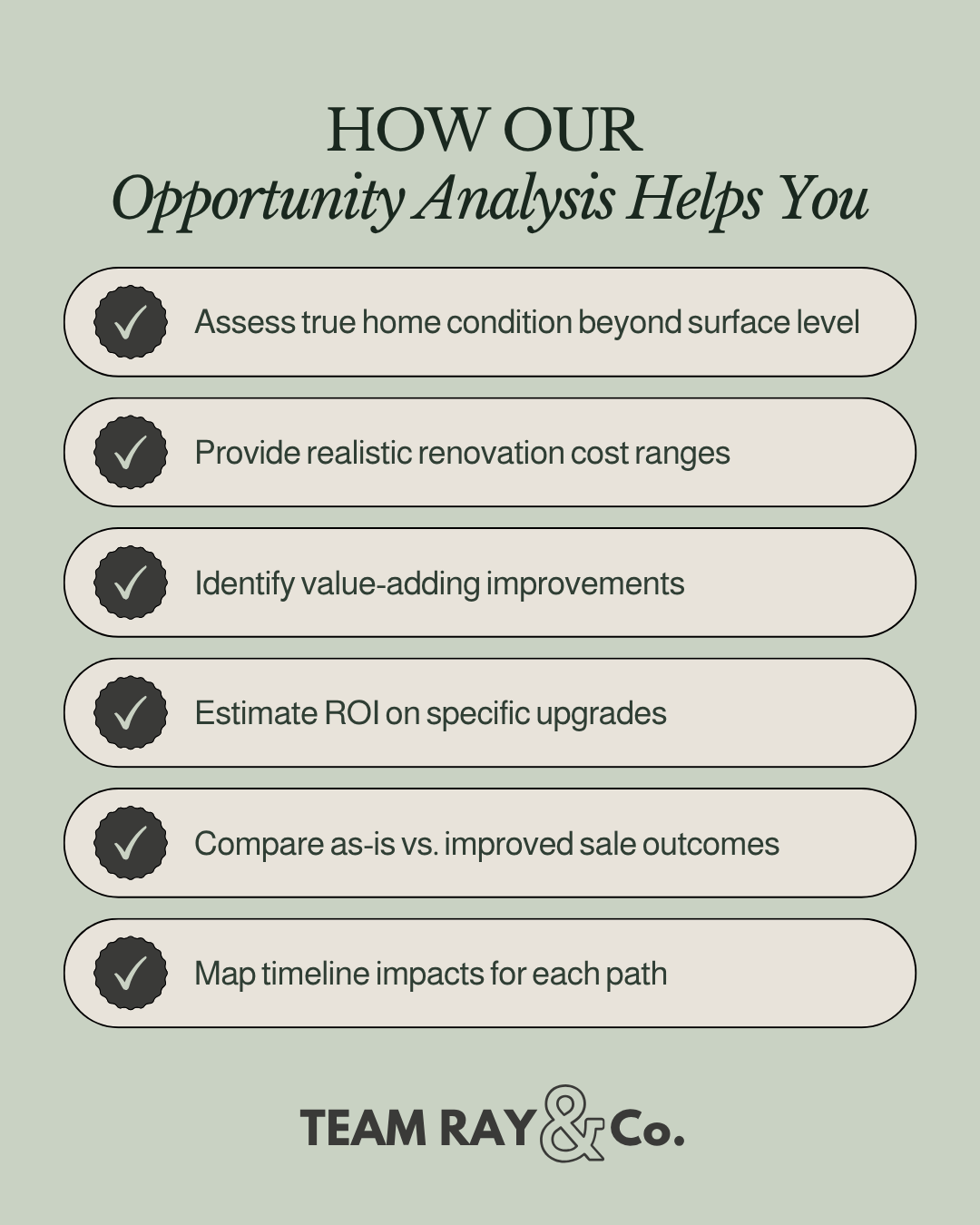
Through an Opportunity Analysis, we can:
Evaluate the home’s true condition beyond surface-level assessment
Provide realistic remodeling cost ranges, not guesses or generic estimates
Identify which improvements actually increase resale value
Show projected ROI for specific upgrades
Compare as-is vs. improved sale outcomes side by side
Map timeline impacts for each path
We don’t just ask what a home will sell for.
We ask what it would sell for if we changed X, Y, or Z, and whether that change is actually worth it.
Because sometimes it is.
And sometimes it isn’t.
Knowing the difference is where the real value lives.
The Real Value: Decision Protection
Most families come to us with uncertainty.
Not just logistical questions like:
Do we fix the house first?
Is remodeling worth it?
What if we don’t get the money back?
But something deeper:
The fear of making an expensive mistake during an already stressful time.
The Opportunity Analysis is designed to remove that uncertainty before any decisions are made and before any money is spent.
It gives families a structured way to understand:
What to do and what not to do
Where money actually moves the needle
What each path looks like financially
How each option affects timeline, stress, and outcome
No pressure. No guesswork. Just a structured decision framework.
The TR&CO Advantage
What makes this work is the combination behind it.
At Team Ray & Co., we operate with two lenses:
Real estate strategy: pricing, positioning, and buyer behavior
Construction insight: real costs, feasibility, and true ROI of improvements
That combination allows us to identify exactly where to invest for the biggest return and where not to spend a dollar.
We also serve as a single point of coordination.
For many families, the hardest part isn’t the decisions themselves. It’s managing multiple contractors, agents, and service providers without a clear plan.
We help organize that complexity into one coordinated strategy.
What Families Walk Away With
At the end of an Opportunity Analysis, families don’t get a pitch.
They get a decision framework.
A clear understanding of:
The best path forward for their specific home
The financial difference between options
The timeline and effort required for each path
A recommended strategy based on their actual goals
Most importantly, they can move forward without second-guessing whether they missed something critical.
Whether that means selling as-is, making strategic improvements, or preparing for a larger life transition, the decision is now informed, not uncertain.
The goal was never to tell families what to do.
It’s to make sure they understand what they’re choosing before they decide.
