

How We Evaluate Renovation ROI
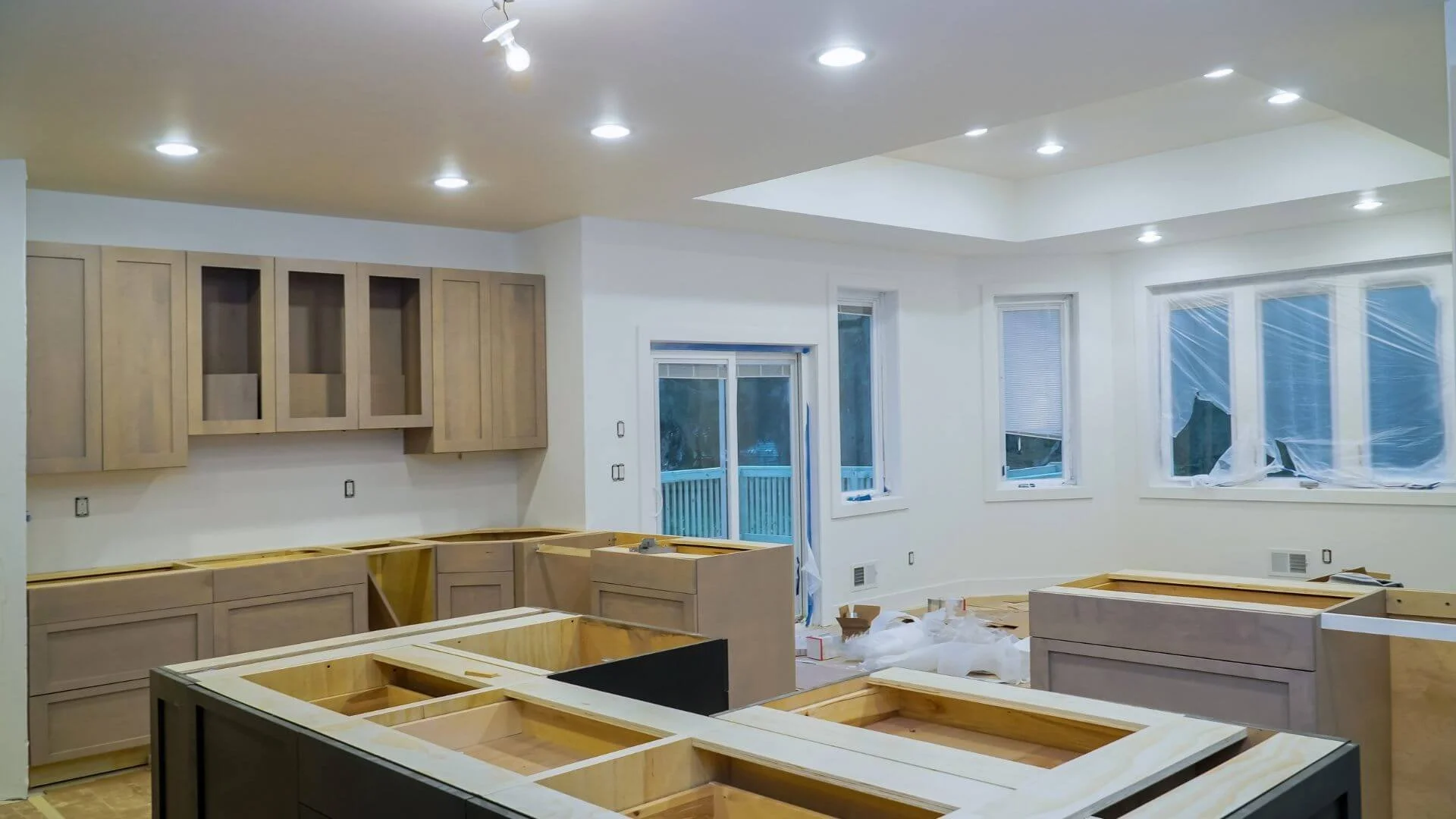
When families start thinking about selling a home, one of the first questions that comes up is whether any renovations are worth doing before listing.
It sounds simple, but it’s actually one of the most financially sensitive decisions in the entire process.
Because the wrong improvement doesn’t just cost money. It can reduce net proceeds, delay the sale, and create unnecessary stress without improving the outcome.
At Team Ray & Co., we evaluate renovation ROI very differently than a typical contractor or real estate agent. Our goal is not to estimate whether a project “adds value” in theory, but whether it improves the homeowner’s actual net outcome in the real market, under real timelines.
ROI Starts With the Exit Strategy
Before we evaluate a single repair or upgrade, we start with one question:
What is the best path to sale for this specific home?
That usually falls into three categories:
Sell as-is for speed and simplicity
Make selective improvements to increase market value
Undertake a more intentional pre-sale renovation strategy
Each of these paths has a completely different ROI framework. A renovation that makes sense in one scenario may be unnecessary or even harmful in another.
That’s why we never evaluate upgrades in isolation. We evaluate them inside the full exit strategy.
The Real Question Is Not “Does This Add Value”
Most renovation advice stops at surface-level assumptions like:
Updated kitchens sell better
New flooring improves appeal
Fresh paint increases value
While these can be true, they are incomplete without context.
We focus on a more precise question:
Does this specific dollar spent return more than it costs, within this specific market and timeline?
That requires three layers of analysis:
Market behavior for that exact price range and neighborhood
True cost of construction, including labor and hidden scope
Timeline impact and carrying costs during the renovation period
Without all three, ROI calculations are incomplete.
Construction-Level Cost Accuracy
One of the biggest mistakes in renovation planning is underestimating cost.
At Team Ray & Co., we use construction-informed pricing rather than generic estimates or online averages.
This matters because ROI is extremely sensitive to cost accuracy.
A project that appears to cost $20,000 on paper can easily become $30,000 or more once real-world conditions are included, such as:
Subfloor or structural surprises
Electrical or plumbing code updates
Material lead times and substitutions
Labor availability and scheduling delays
Even small miscalculations can completely change whether a project is worth doing.
Market Response Is Not Linear
Another key factor is that buyer response is not linear.
A $10,000 improvement does not automatically create $10,000 in value.
Sometimes it creates very little or no measurable return.
Other times, a small targeted improvement can significantly increase buyer interest, reduce days on market, or strengthen offers.
We evaluate this by looking at:
What buyers in that specific segment expect as baseline condition
What improvements move a home into a different competitive tier
What upgrades are emotionally influential versus financially irrelevant
The goal is not to make the home “nicer.” The goal is to make it more competitive where it matters.
Timing Is Part of ROI
Time is one of the most overlooked components of renovation ROI.
Every improvement has a timeline cost that affects:
Carrying costs (mortgage, taxes, utilities)
Market exposure timing
Buyer seasonality
Competing inventory changes
In some cases, a renovation that adds value on paper loses value in reality because it delays the sale into a weaker market window or increases holding costs.
We always evaluate ROI with time included, not as a separate factor.
The Opportunity Analysis Framework
This is where our Opportunity Analysis process becomes essential.
Through our work at Team Ray & Co., we break renovation decisions into a clear comparison:
As-is value and speed of sale
Select improvement scenarios with cost and return estimates
Full renovation scenarios when applicable
Net outcome comparison across all paths
This allows families to see not just what they could do, but what they should do based on real tradeoffs.
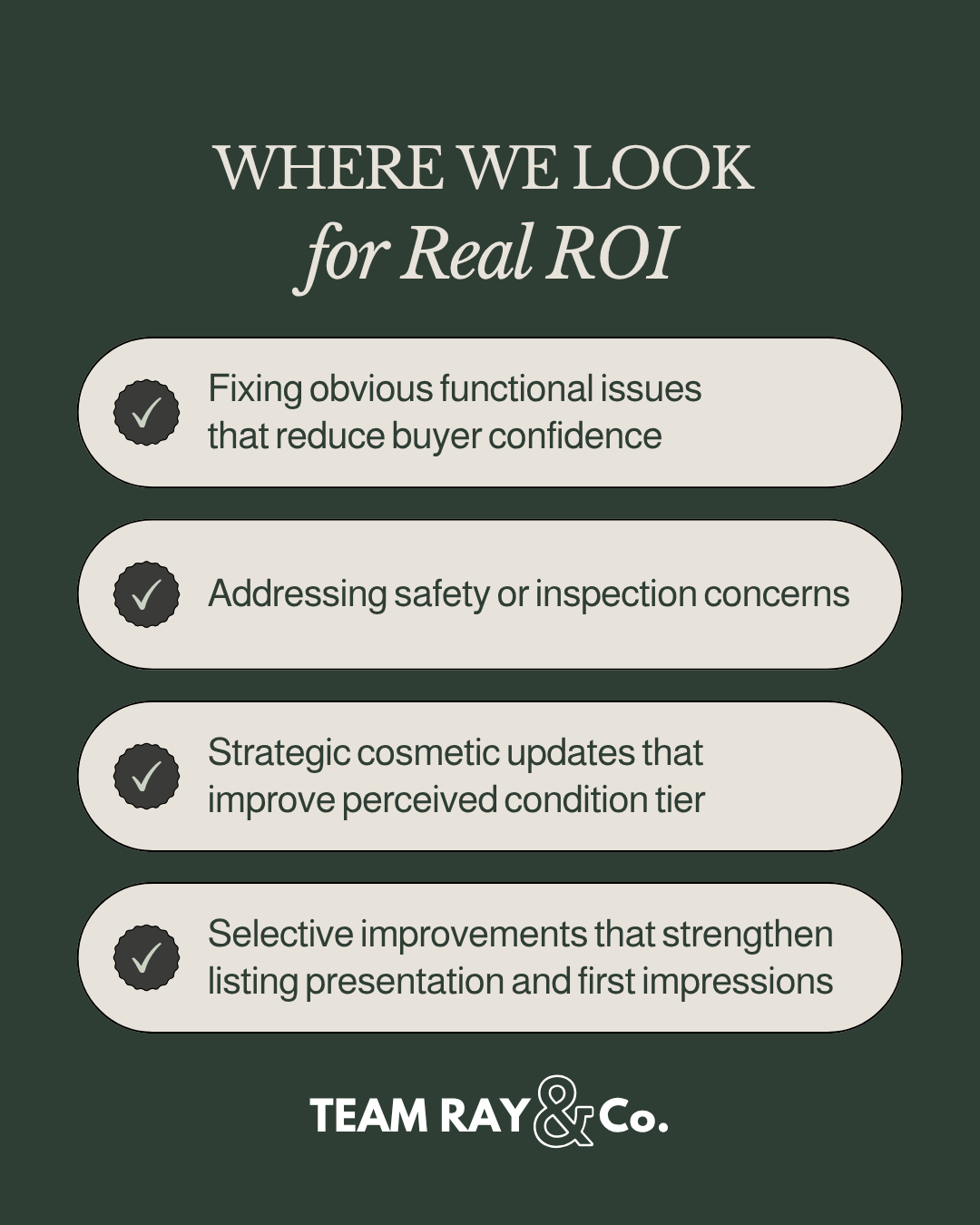
Where We Look for Real ROI
In practice, the highest ROI improvements usually fall into a few categories:
Fixing obvious functional issues that reduce buyer confidence
Addressing safety or inspection concerns
Strategic cosmetic updates that improve perceived condition tier
Selective improvements that strengthen listing presentation and first impressions
We are equally focused on identifying what not to do, because unnecessary work is one of the fastest ways to reduce net proceeds.
The Goal Is Net Outcome, Not Activity
A common misconception is that more preparation always leads to better results.
In reality, the best outcome is often the simplest one.
Our role is to help families avoid unnecessary projects, avoid emotional over-improvements, and focus only on actions that improve their actual financial and timing outcome.
That means sometimes recommending renovations.
And just as often, recommending none at all.
Final Thought
Renovation ROI is not a formula. It is a decision framework.
It requires understanding construction costs, buyer behavior, market timing, and most importantly, the specific goals of the family involved.
The right answer is never “always renovate” or “never renovate.”
The right answer is:
What creates the best net outcome for this home, in this market, at this moment in time.
