

The Rooms We Stop Using: What Happens When Our Homes Become Bigger Than Our Lives

The rooms we stop using are often a reflection of how much our lives have changed.
A home can continue to hold the shape of an earlier chapter long after that chapter has ended. The routines that once filled our days may be different now. The household may have become smaller. The things that once brought us into certain parts of the house may no longer be part of everyday life.
And so, gradually, there are rooms we stop using.
Not because anything is necessarily wrong with them, but because our lives no longer require them in the same way. A space that once felt essential can become quiet. A room that once belonged to daily life can become something we pass by. Eventually, we may realize that part of our home is no longer connected to the way we actually live.
That doesn't mean every room needs to be used every day. Some spaces are worth keeping precisely because they give us flexibility. A room can sit quietly until we need it for guests, creativity, rest, or a special occasion.
But the rooms we stop using can still make us pause and ask a bigger question:
What does our home tell us about the life we are living today?
Sometimes, the answer isn't that we need a smaller home or fewer belongings. Sometimes, we simply need to recognize that our home has been holding on to a version of our life that has already changed.
When a Home Preserves an Earlier Version of Us
Most homes change much more slowly than the people who live in them.
We might move into a house because it works for a particular season of life. There is room for children, a home office, overnight guests, holiday gatherings, hobbies, or all the things we imagine we might need someday. At the time, the extra space makes perfect sense.
Then ten or twenty years pass.
The children leave. The home office becomes a storage room. The formal living room becomes a place where boxes are temporarily placed, although "temporarily" starts to mean several years. The dining room table becomes the place where mail accumulates because no one actually eats there. The room upstairs is still called "Sarah's room," even though Sarah has lived somewhere else for years.
This is one of the quiet ways a home becomes a record of our history.
There is nothing wrong with that. In fact, there can be something deeply reassuring about walking into a room and seeing traces of the people and experiences that mattered to us. Homes are not supposed to look like hotel rooms. They are allowed to contain memories.
But there is a difference between a room that carries our history and a room that requires us to keep living around that history.
That distinction is worth noticing.
An Unused Room Is Not Necessarily an Unnecessary Room
It is easy to look at an unused room and immediately think it needs a new purpose. We have been taught to maximize every square foot. If a room isn't being used every day, we are encouraged to turn it into an office, a gym, a rental, a craft room, or something else that can be justified.
But not every space needs to earn its keep.
Sometimes an empty room is useful precisely because it is available. A guest room doesn't need a guest every week to have value. A quiet sitting room can be somewhere to read when the rest of the house feels busy. A room that is mostly empty may give a household flexibility that isn't obvious until it is needed.
The problem begins when we stop choosing what the room is for and simply allow it to become whatever happens to accumulate there.
There is a big difference between an unused room and a room that has become storage because nobody knows what else to do with the things inside it.
One is a choice.
The other is often a decision that has been postponed.
So instead of asking, "Are we using this room enough?" a better question might be:
Does this space still serve a purpose that matters to us?
The answer doesn't have to be practical. It can be emotional, social, creative, private, or simply comforting.
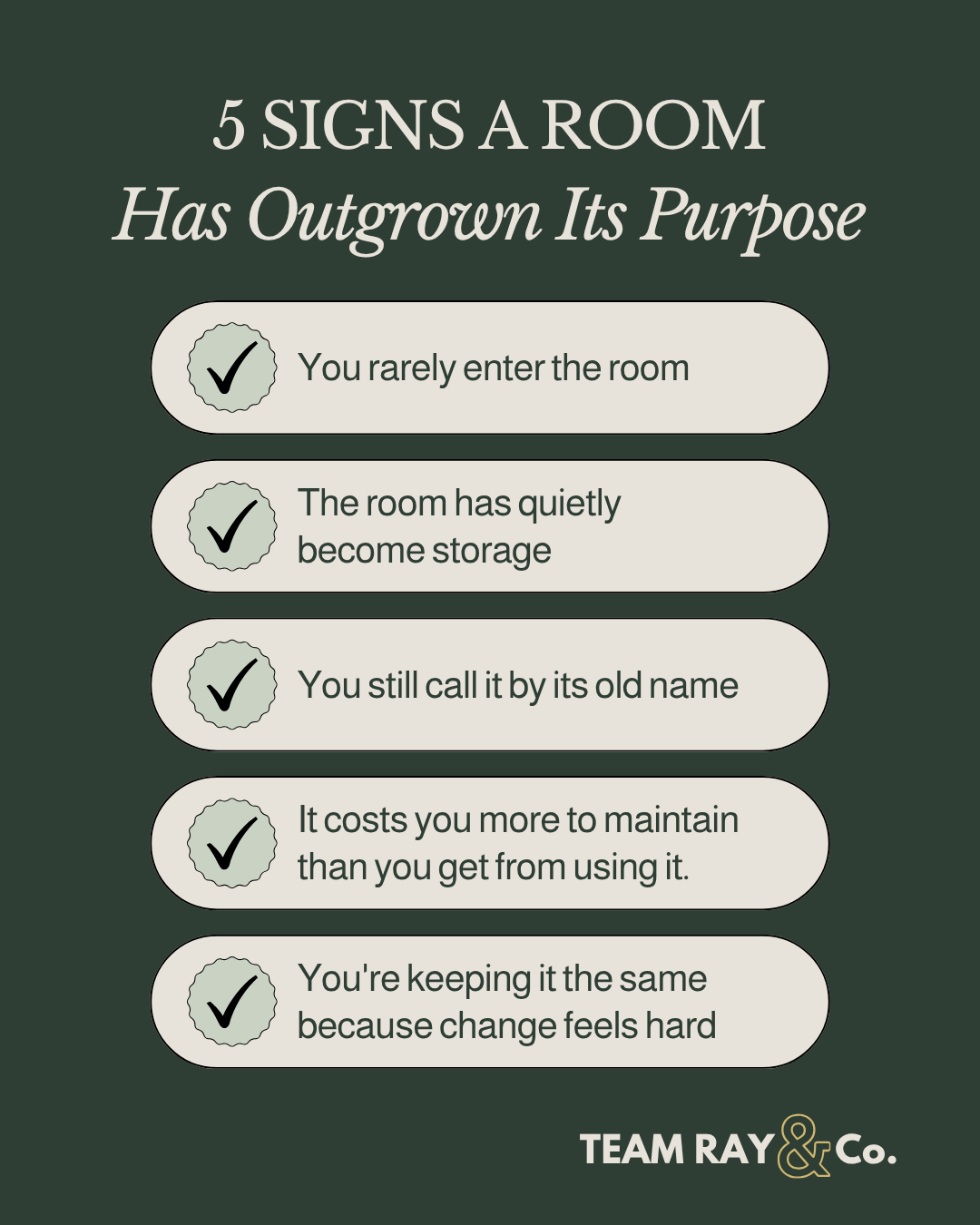
5 Signs a Room in Your Home Has Outgrown Its Purpose
Sometimes it is difficult to recognize that a room has stopped fitting our current life because we are so accustomed to seeing it the way it has always been. A few clues can help us look at it differently.
You rarely enter the room unless you need to retrieve something. A room that was once part of everyday life may have gradually disappeared from your routine.
The room has become the default place for things that don't have another home. Boxes, paperwork, old furniture, seasonal decorations, and miscellaneous belongings tend to collect wherever decisions haven't been made.
You still describe the room by someone who used to use it. "The kids' room" or "Dad's office" can remain the name long after the room's actual function has changed.
Maintaining the room takes more effort than using it. Cleaning, heating, cooling, repairing, and furnishing a space all require time and money, even when the room is rarely occupied.
You are keeping it exactly the same because changing it feels difficult. Sometimes the resistance isn't about the room itself. It is about what changing the room might represent.
That last one deserves some attention.
A room can become emotionally complicated without us realizing it. Changing a child's old bedroom can feel like acknowledging that a particular stage of family life is over. Taking apart a late parent's room can feel like disturbing something that should remain untouched. Packing away a collection or hobby can feel like admitting that we are no longer the person who once spent hours doing that thing.
In those situations, the room is carrying more than furniture.
It is carrying meaning.
And meaning doesn't always need to be discarded simply because a room needs to change.
When Storage Takes Over Living Space
Storage is one of the easiest ways for a home to become disconnected from the life happening inside it.
A box gets moved into the spare bedroom because there is nowhere else to put it. Another box goes beside it. Holiday decorations arrive in November and disappear again in January, but nobody really decides where they should live. Old paperwork is kept because it might be important. Furniture stays because someone may need it someday. A closet becomes a place for things that are neither used nor ready to be let go.
Eventually, a room can become difficult to use for anything else.
This doesn't happen because people are careless. Most of the time, it happens because decisions about belongings are surprisingly difficult. Keeping something requires no decision at all. Getting rid of it requires deciding what it is worth, whether it is needed, whether someone else could use it, and whether we are ready to part with it.
That is a lot of decisions.
Sometimes it helps to approach the problem from the room rather than the belongings. Instead of opening every box and asking, "Do I still want this?" start by asking:
If I needed this room for something else tomorrow, what would have to move?
The answer can tell you a lot.
Maybe almost everything in the room is meaningful and simply needs to be organized. Maybe most of it hasn't been touched in years. Maybe the room is doing exactly what you want it to do. There is no predetermined right answer. The point is to notice what is actually happening.
The Upstairs Problem
There is another pattern that can be easy to overlook: sometimes it isn't one room that has become unnecessary to daily life. It is an entire section of the house.
The upstairs bedrooms may rarely be used. The laundry is downstairs. The kitchen and living room are where everyone spends time. The home office is nearby. The stairs become something you climb because you have to, rather than because anything important is happening up there.
Over time, daily life naturally contracts toward the areas that are easiest and most convenient.
This can happen at almost any age. A young family may eventually move bedrooms around as children grow. Someone working from home may use a room differently than they did before. After retirement, routines may change again. A household of four can become a household of two. A home that once felt perfectly proportioned can suddenly feel like there is a lot of house surrounding a relatively small amount of daily activity.
That doesn't mean something is wrong.
It does mean it can be useful to notice where life actually happens.
For one week, pay attention to which rooms you naturally use. Where do you drink your morning coffee? Where do you read? Where do conversations happen? Where do you spend time when you aren't doing anything in particular?
You might discover that your favorite parts of the house are not the ones you originally thought would matter most.
When the House Starts Requiring More From Us
The size of a home is often discussed in terms of square footage, bedrooms, bathrooms, and property value. But there is another measurement that rarely gets talked about: how much life the house asks from us.
Every room needs some level of care. Floors need cleaning. Windows need attention. Heating and cooling costs money. Roofs, gutters, plumbing, appliances, landscaping, paint, furniture, and repairs all become part of the ongoing responsibility of owning a home.
When every part of a house is actively supporting your life, those responsibilities can feel worthwhile.
But when large portions of the home are rarely used, the balance can change.
It can be helpful to occasionally ask:
How much time do we spend maintaining rooms we rarely use?
Are there areas of the house that are becoming harder to access or care for?
Are we heating or cooling spaces that are almost always empty?
Do we still need the amount of storage we once did?
Is the layout helping our routines or making them more complicated?
If we were designing our home for our current life, would we choose this much space?
These aren't questions about whether you should move.
They are questions about whether your home is still working for you.
Giving a Room a New Job
Once we notice that a room no longer fits our life, there is no need to immediately decide what to do with it.
Sometimes the best first step is simply to imagine what else might be possible.
The old guest room could become a comfortable reading room or a place for grandchildren to spend time. A formal dining room could become the everyday dining space it was always meant to be, rather than waiting for special occasions. A former child's bedroom might become a workspace, studio, exercise area, or simply a more comfortable room for visiting family.
The question isn't, "What should we turn this room into?"
It might be:
What would make this room useful to the person I am now?
That small shift changes the conversation.
You are no longer trying to make the house more productive. You are making it more aligned with your actual life.
And sometimes the answer is surprisingly simple. Maybe the room needs better lighting. Maybe the furniture needs to be moved. Maybe the boxes need to leave. Maybe a desk that has been squeezed into a corner of the living room could finally have its own space.
A room doesn't necessarily need a dramatic makeover.
Sometimes it just needs permission to become something different.
You Don't Have to Change Everything at Once
There is a temptation, once we start noticing these things, to see the entire house as a project.
That can become overwhelming quickly.
Instead, choose one room that has been bothering you. Spend some time in it. Open the curtains. Turn on the lights. Sit down. Look at what is actually there rather than what you remember being there.
Ask yourself:
What do I currently use this room for?
What do I wish I could use it for?
What is getting in the way?
Which things in here still matter to me?
What would I miss if this room changed?
What could stay even if the room's purpose changed?
You may decide to change nothing.
That is still useful information.
Sometimes noticing that a room is intentionally empty can make it feel different from a room that has simply been forgotten.
What an Empty Room Really Means
An empty room isn't always a problem to solve. We tend to see unused space as a sign something's wrong — a bedroom with no child in it, a dining room that's gone quiet, a hobby room without its hobbyist.
But an empty room can mean something good, too. It can mean a child grew up. A career changed. A family doesn't need as much space as it used to. Someone finished a chapter of their life.
Our homes naturally carry traces of the past, and trying to erase all of them would make a house feel disconnected from the life lived in it. The goal isn't to update every room — it's to leave space for both the past and the present. A room can hold a memory without staying frozen in time.
A Gentle Room-by-Room Reflection
You don't need a major project to begin thinking differently about the space you live in. Walk through your home slowly and notice what you usually overlook.
For each room, consider:
Who uses this room now?
What actually happens here?
How often is it used?
What takes up most of the space?
Is that what I would choose to have here today?
Does this room make something in my life easier?
Does it create work that I don't really need?
Is there a different purpose that would serve my current life better?
If I changed this room, what part of its history would I want to preserve?
You don't have to answer every question.
Even one honest answer can change how you see a space.
A Home Is Allowed to Evolve
Our homes are often treated as permanent things. We buy them, arrange them, decorate them, maintain them, and assume that the basic way we use them will remain more or less the same.
But our lives don't work that way.
People move in and out. Families grow and change. Work changes. Bodies change. Interests change. Responsibilities change. The amount of time we spend at home changes. What we need from our surroundings changes along with us.
It makes sense, then, that our homes would need to evolve too.
That doesn't always mean moving to a smaller house. It doesn't necessarily mean renovating. It doesn't mean getting rid of everything that belongs to an earlier chapter. Sometimes evolution is as simple as moving a chair closer to the window because that's where you actually like to sit now.
Maybe the dining room becomes the room where you have coffee with a friend. Maybe the guest room becomes a place where you finally pursue a hobby you've been putting off. Maybe the upstairs bedroom stays exactly as it is because, for now, that's what feels right.
There is no rule that says every square foot has to be optimized.
Our homes are allowed to contain quiet spaces, sentimental spaces, occasional spaces, and spaces whose purpose is still being figured out.
What matters is that we notice them.
Because sometimes a room tells us something about our lives before we are ready to say it ourselves. It shows us what has changed, what we still value, what we are holding onto, and where our everyday life has quietly moved.
And perhaps that is the most useful reason to pay attention.
Not because every unused room needs to be changed, but because our homes give us an opportunity to notice the life we are actually living.
The question may not be, "Do we need all this space?"
It may simply be:
Does the space around us support the life we want to live today?
