

The 20-Minute Reset: Small Changes That Can Make a Home Feel Better

The 20-Minute Reset is not about cleaning your entire home. It is about changing how a space feels with a few small, intentional adjustments.
Sometimes a home doesn't need to be cleaned from top to bottom. It doesn't need a renovation, a new sofa, a weekend spent filling donation bags, or a complete reorganization of every closet. Sometimes, a room simply feels a little off.
The curtains have been closed all day. The kitchen counter has collected a few things that don't belong there. The lighting feels too harsh. A chair has become the place where everything gets dropped. A television or podcast is playing in the background, even though no one is really listening.
Nothing is necessarily wrong with the house. It just doesn't feel particularly good to be in.
That is where a small reset can make a surprising difference.
A reset isn't the same thing as cleaning, and it isn't another word for decluttering. The goal isn't to make your home look perfect. It's to make a few small changes that help the space feel more comfortable, functional, or peaceful for the people actually living there.
You don't have to tackle the whole house. You don't even have to finish everything you start.
Sometimes, twenty minutes is enough to change the feeling of a room.
Start by Looking at the Room Differently
Our surroundings have a way of becoming background noise. We stop noticing the pile of mail on the counter because it has been there for several days. We get used to the lamp that isn't quite bright enough. We stop seeing the laundry basket in the hallway or the chair that has been sitting in the wrong place for months. We simply adapt. We walk around things, reach a little farther, leave a light off because it is too bright, or put something down wherever there happens to be an empty spot.
None of these things seems important enough to deal with on its own, but together they can make a space feel more tiring than it needs to be. A twenty-minute reset is really an opportunity to interrupt that autopilot. Instead of accepting the room exactly as it is, take a fresh look at it. What is making the space feel busy? What is making it uncomfortable? What would make it easier to be here?
You may be surprised by how simple the answers are.
Start with the light. Before moving furniture or deciding what needs to be cleaned, open the curtains or blinds and let some natural light into the room. If it is evening, pay attention to the artificial lighting instead. A room with one bright overhead light can feel very different from a room with a lamp beside a chair or a softer light in the corner. You may not need to buy anything. Sometimes the lamp you already own simply needs to be moved closer to where you actually sit.
A few ways to start:
Turn off the light you don't need
Open a curtain you normally keep closed
If there is a window you rarely look out of, take a moment to actually look through it
Light changes how we experience a space, and it is one of the easiest things to change without changing the room itself.
Then choose one surface and clear it. Not the entire kitchen. Not every countertop in the house. Just one surface that your eyes land on often. It might be the kitchen island, coffee table, bathroom counter, entryway table, or desk. Remove the things that don't belong there and give them somewhere else to go. You don't need to make decisions about every item you find.
If there is paperwork that needs attention, put it together in one place
If something belongs upstairs, set it near the stairs
If something belongs in another room, take it there when you can
The goal isn't to complete an organization project. It is simply to give your eyes somewhere to rest.
You may find that you don't actually want the surface completely empty. Once the unnecessary things are gone, perhaps the bowl of fruit, vase of flowers, stack of books, or family photograph that remains is exactly what you want there. The goal isn't emptiness. It is intention.
Put Things Back Where They Belong
There is also a difference between clutter and things that are simply out of place. A pair of shoes beside the sofa, a mug on the desk, a book on the kitchen counter, a phone charger in the living room, or a jacket over the dining chair doesn't necessarily mean your home is cluttered. It means life has been happening.
Choose five things and return them to where they belong. That's enough. You may naturally put away ten more once you get started, but you don't need to make that the goal. There is something satisfying about restoring a little order without turning it into a project. It reminds you that your home doesn't need to be perfectly organized to feel cared for. Sometimes it just needs a few things returned to their places.
While you're doing this, pay attention to the things that repeatedly end up in the wrong place. That can tell you something useful about how your home is actually functioning.
If the same shoes always end up beside the door instead of in the closet, perhaps the closet isn't the right place for the shoes you wear every day
If mail continually ends up on the kitchen counter, maybe that is where you naturally want to deal with it, and it would make more sense to create a small, intentional place for it there
If the blanket always ends up on the sofa, perhaps it belongs in a basket beside the sofa rather than in a linen closet across the house
Our homes don't have to be arranged according to an ideal version of how we think we should live. They can be arranged around how we actually live. That is one of the simplest ways to make a home feel better without buying anything.
Pay Attention to What You Hear
We spend a lot of time thinking about how our homes look, but sound can have just as much influence on how a space feels. A television playing in the background can make a room feel occupied even when nobody is watching. Phone notifications create their own kind of background noise. Appliances hum, traffic comes through the windows, and sometimes a podcast continues playing long after everyone stopped listening.
For twenty minutes, try changing the sound of the room:
Put on music you genuinely enjoy
Open a window if the sounds outside are pleasant
Turn off the television
Let the house be quiet for a while
There doesn't have to be anything particularly meaningful about the music. It could be an old album you haven't heard in years, something upbeat while you move around the house, or something soft while you sit with your coffee. The point is simply to become aware of the sound environment rather than accepting whatever happens to be playing.
Sometimes what a room needs isn't another object. It needs less noise.
And sometimes what you need is a few minutes outside. If you've been inside working, cleaning, watching television, cooking, scrolling, or moving from one indoor task to another, step outside for five minutes. Stand on the porch. Walk to the mailbox. Sit on the balcony. Water a plant. Take the trash out and take an extra minute before coming back inside. You don't need to turn it into exercise or even call it a walk. Just go outside.
When you come back in, notice the room again. Often the reset isn't about changing the space at all. It is about changing the way you are entering it.
Give an Unused Corner a Purpose
Most homes have a corner that has gradually become whatever was convenient. There might be a chair with a pile of clothes beside it, a small table covered with papers, a corner of the bedroom where bags accumulate, or a section of the living room that has never quite become anything.
Instead of asking what you should put there, ask what you would actually enjoy doing there.
Maybe it could become a comfortable reading corner
Maybe it is the place where you drink your morning coffee
Maybe you want somewhere to sit without a television on
Maybe it could become a small writing space, a place for puzzles, a spot for a hobby, or simply a comfortable chair beside a window
It doesn't need to be elaborate. A corner can become meaningful simply because you've decided what you want it to support.
The same idea can be applied to things you use every day. Think about something that is slightly inconvenient:
Maybe your coffee mugs are stored too far from the coffee maker
Maybe the shoes you wear most often are buried in a closet
Maybe your phone charger is always across the room
Maybe the blanket you use every evening is kept in a basket that is difficult to reach
Move it.
We sometimes assume that our homes have to remain arranged according to the way they were originally designed, or according to some organizing rule we learned years ago. But the best arrangement is usually the one that supports the life actually happening in the room. If you use something every day, it should be easy to reach. If something is used once a year, it probably doesn't need prime real estate.
This isn't really about organization. It's about paying attention to your habits.
Make Room for Doing Nothing
There is another small change that can make a home feel better: creating a place where you aren't expected to accomplish anything.
Most of our homes are organized around activity. There is a desk for working, a kitchen for cooking, a laundry room for laundry, a table for paperwork, a television for entertainment, and perhaps a treadmill or exercise equipment somewhere nearby. Even our quiet spaces can come with an expectation attached to them.
It can be nice to have one place that doesn't.
It might be a chair near a window, a corner of the porch, the end of the sofa, or a small space beside a bookshelf. What matters is that the space doesn't come with a list of responsibilities. You can sit there with a cup of tea, listen to music, look outside, talk to someone, read a few pages, or do absolutely nothing.
We tend to fill our homes with evidence of productivity. A quiet corner offers a different message. You can just be here.
That may be particularly valuable in a home that has started to feel like one long list of things to do. Sometimes creating calm isn't about adding something beautiful. It is about removing the expectation that every space has to be useful.
Don't Forget the Way You Come Home
The entryway deserves a little attention because it has an outsized effect on how the rest of the house feels. It is the first place you encounter when you come home and often the last place you see when you leave. If it is crowded with shoes, bags, packages, coats, paperwork, and things that need to be carried somewhere else, the house can feel busy before you've even walked into it.
Spend a few minutes putting away what doesn't belong there:
Give the things you use every day an obvious place
Move anything that has been sitting there simply because nobody knew where else to put it
Then leave some breathing room
You don't need a perfectly styled entryway. You just want coming home to feel a little easier.
The same principle applies throughout the house. Pay attention to the small points of friction that you encounter repeatedly:
Is there a drawer that is always difficult to open because it is too full?
Is there a chair that blocks the natural path through a room?
Is there something you have to move every morning before you can use the space you need?
Is the item you reach for most often stored in the least convenient place?
These are small problems, but they happen every day. Fixing one of them can make a surprisingly noticeable difference.
Try the Twenty-Minute Reset
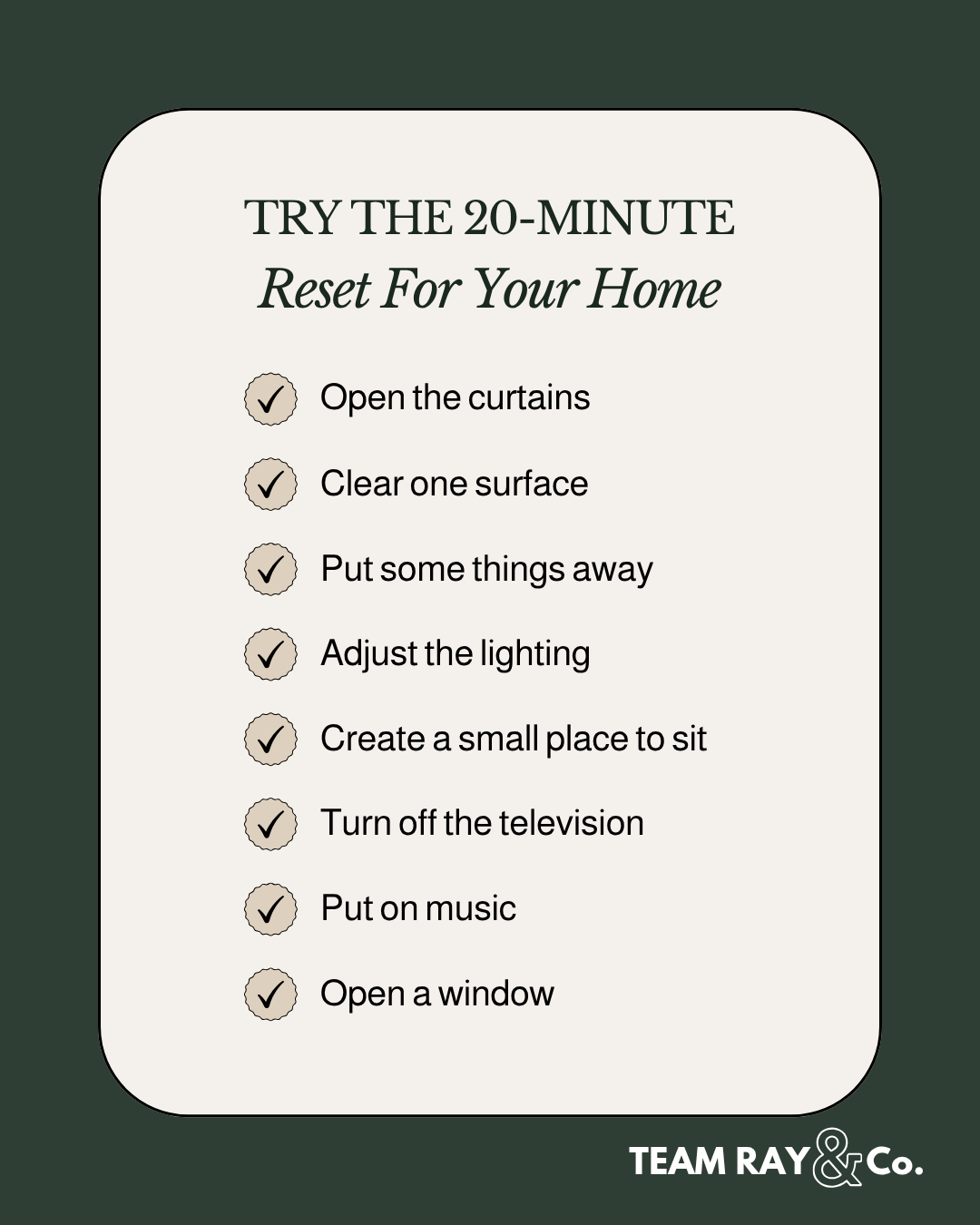
If you want to try this without turning it into another task on your list, set a timer for twenty minutes and choose one room. For the first few minutes, don't do anything. Just look around. Notice what feels good and what feels unnecessarily busy, difficult, dark, noisy, or inconvenient.
Then choose a few small changes:
Open the curtains
Clear one surface
Put some things away
Adjust the lighting
Create a small place to sit
Turn off the television
Put on music
Open a window
At the end of twenty minutes, stop.
You don't need to finish everything. In fact, leaving something unfinished may be part of the point. A home is not a project that can ever truly be completed. People live in it. Things get moved. Meals get made. Shoes end up by the door. Someone leaves a book on the coffee table. A package arrives. A glass gets left beside the sofa. Life creates a certain amount of disorder.
We don't need to eliminate that. We just need to occasionally restore enough calm to notice the difference.
A Home Doesn't Have to Be Perfect to Feel Good
There is a version of home improvement that is always asking for more. More organization. More storage. Better furniture. Better finishes. A cleaner kitchen. A more beautiful living room. A more efficient closet.
There is nothing wrong with wanting those things, but sometimes the most meaningful improvement is much smaller:
Open the curtains
Move the chair
Put the shoes away
Turn off the television
Play the song you love
Step outside
Make yourself a comfortable place to sit
These things sound almost too simple to matter, but our experience of home is built from hundreds of small interactions like these. The way we enter a room, the light we wake up to, the surface we see while drinking our coffee, the chair we sit in at the end of the day, and the path we take through the house all contribute to how a home feels.
When those little things work well, the home can feel more supportive without looking dramatically different.
Maybe that's the real value of a reset. It doesn't ask you to become a different person or create a different home. It simply gives you a chance to notice the space you already have and make a few small adjustments around the life you're actually living.
Twenty minutes won't transform your house. It might, however, change how you feel when you sit down in it.
