

The Kitchen Test: What Your Kitchen Can Tell You About Your Current Life
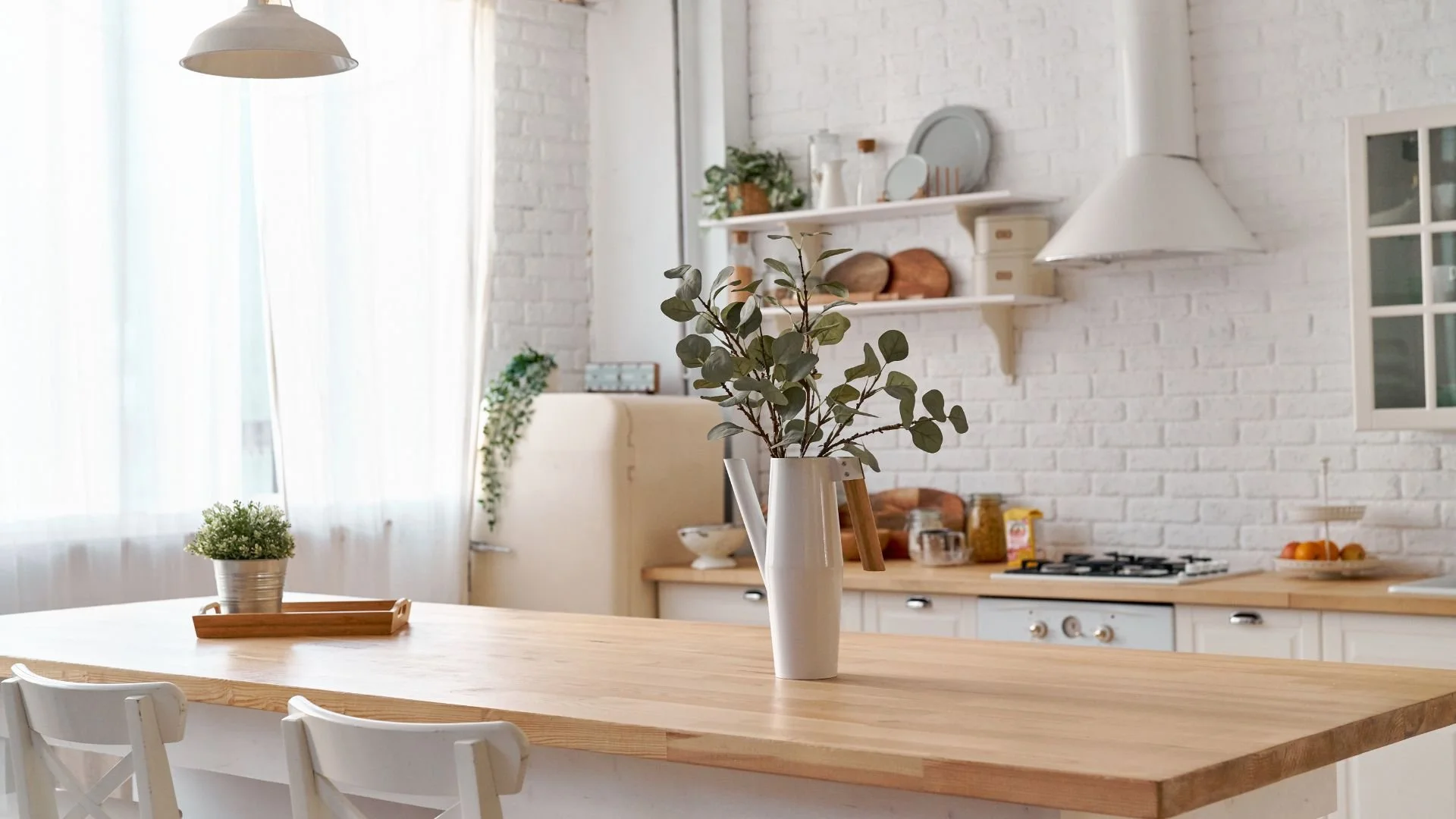
The Kitchen Test is a simple way of noticing whether the space around you still reflects the way you actually live.
The kitchen is often one of the most revealing rooms in a home because our routines tend to show themselves there without much effort. What we reach for every morning, what we use every week, what stays untouched, and where things inevitably collect can tell us a lot about our current habits.
Sometimes, that story is different from the one our kitchen was originally designed for.
Maybe the household has changed. Perhaps the way you cook has changed. You may have once enjoyed elaborate meals but now prefer something simple. An appliance that used to be part of your weekly routine may now sit untouched in a cabinet. A large refrigerator, extensive cookware collection, or specialty gadget may have made perfect sense for an earlier version of your life.
None of that means you made a bad purchase or that something is wrong with your kitchen.
It simply means your life changed.
The kitchen doesn't always change along with it.
And that is what makes the kitchen test interesting. Instead of asking whether your kitchen is organized enough or whether you have too many things, you can ask a more useful question:
Does this kitchen support the way I live today?
The answer can reveal more than what needs to be cleaned or put away. It can show us which routines have stayed, which ones have changed, and where our homes may still be holding on to an earlier version of our lives.
Your Kitchen Is a Record of Your Routines
Walk into your kitchen and look at the things that are easiest to reach.
What is sitting on the counter?
Which cabinet doors open every day?
Which drawers are used constantly?
What is closest to the stove, coffee maker, sink, or refrigerator?
There is usually a pattern.
The things we use most often tend to migrate toward convenience. The coffee maker gets its own permanent spot. The favorite mugs are always in the same cabinet. The knives we actually use are rarely the ones hidden at the back of a drawer. The frying pan that makes dinner three nights a week is probably much easier to reach than the beautiful pan that gets used twice a year.
Over time, our kitchens quietly organize themselves around our habits, even when the cabinets and counters haven't been intentionally rearranged.
That is worth paying attention to.
A kitchen designed for a family of five may function very differently for two people. A kitchen built around someone who loved to cook every evening may look excessive after retirement or a change in routine. A person who once packed lunches every morning may now eat differently. Someone who entertained frequently may no longer host large gatherings. A household that used to rely on the dining table every night may now eat at the kitchen island or in front of the television.
The kitchen remembers all of these versions of us.
The question is whether it still needs to be arranged for them.
The Appliances We Keep Using and the Ones We Don't
One of the easiest ways to take the kitchen test is to look at your appliances.
Not just the large ones. Look at everything.
Consider:
Which appliances do you use several times a week?
Which ones come out only during the holidays?
Which ones haven't been used in so long that you would need to look up the instructions before turning them on?
Most kitchens accumulate appliances gradually. One is purchased because a recipe calls for it. Another is a gift. Another is something you thought would make life easier. Some genuinely become part of your routine. Others don't.
The interesting part isn't deciding which appliances are "good" or "bad." It is noticing whether the space they occupy matches how often you actually use them.
If the toaster, coffee maker, or kettle is used every morning, it makes sense that those things should be easy to access. If a specialty appliance is used twice a year, perhaps it doesn't need to live on the counter. It could have a place farther back in a cabinet or pantry where it isn't competing with the things you use every day.
This sounds obvious, but kitchens often work the opposite way. We leave things out because we once used them frequently, because putting them away is inconvenient, or because the counter became their permanent home before we had a chance to reconsider.
A useful question is:
If I were setting up this kitchen for the first time today, which appliances would I choose to have within reach?
The answer might surprise you.
You may discover that the things you use most are remarkably simple.
Open the Cabinets You Avoid
There are usually a few cabinets in every kitchen that we don't particularly enjoy opening. Maybe something is awkwardly stacked inside. Maybe the shelves are too deep. Perhaps you have to move three things to reach the one thing you actually want. Maybe the cabinet is so full that you can't see what's there.
We tend to adapt to these inconveniences. We keep the plates we use most often on the lower shelf because the upper shelf is difficult to reach. We stop using a particular bowl because it is always behind something else. We buy another measuring cup because the original one is buried somewhere in the back of a drawer.
The problem isn't necessarily that we have too many things. Sometimes the problem is that the kitchen isn't arranged around the way our bodies and routines work today.
Open the cabinets and drawers with fresh eyes. Ask yourself:
Which ones are easy to use?
Which ones require reaching, bending, lifting, or rearranging?
Are the things you use most often stored in the most convenient places?
If something is difficult to reach and you use it every day, that deserves attention.
And if there are things you rarely use taking up the easiest-to-reach spaces, perhaps they can move. You don't have to throw anything away. You can simply change the order.
The kitchen should work for the person using it, not for the way someone imagined the kitchen would be used when it was designed.
What Your Kitchen Is Telling You
Before changing anything, take a few minutes to simply observe. You may start noticing patterns that aren't obvious when you're rushing through breakfast or trying to get dinner on the table.
Look for things like:
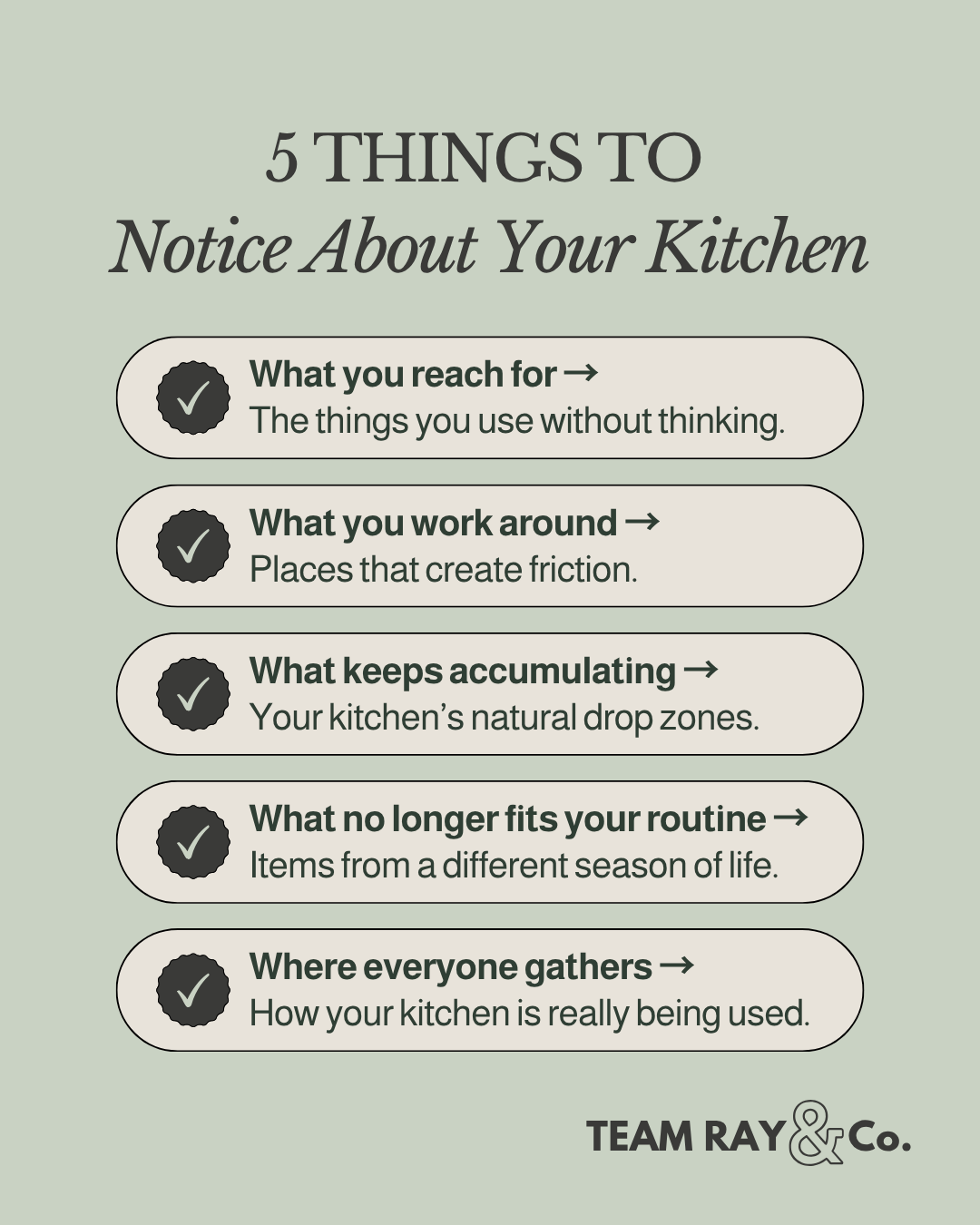
What you reach for without thinking: These are the items that are genuinely part of your current routine and probably deserve the easiest access.
What you work around: A crowded counter, difficult cabinet, rarely used appliance, or awkward piece of furniture may be creating friction you have simply learned to accept.
What keeps accumulating: Mail, grocery bags, water bottles, paperwork, or other everyday items can reveal where your kitchen naturally becomes a drop zone.
What no longer matches your routine: Specialty cookware, serving pieces, appliances, or food-storage containers may belong to a version of your household that has changed.
Where people naturally gather: The place everyone ends up standing or sitting may tell you more about how the kitchen functions than the room's original layout does.
None of these observations needs to become a project.
They are simply clues.
What Are You Actually Cooking?
The contents of the refrigerator and pantry can tell another story.
Maybe you used to cook elaborate meals from scratch, but these days you prefer simple breakfasts and easy dinners. Maybe you once kept ingredients for large family meals but now cook for one or two people. Maybe your schedule has changed and you find yourself preparing meals at different times.
Maybe you still love cooking, but you have discovered that you would rather make three simple dishes really well than spend an entire evening preparing something complicated.
There is nothing wrong with any of these changes.
In fact, they are normal.
Our kitchens sometimes hold onto an older version of our eating habits long after those habits have changed. The specialty ingredients remain in the pantry. The enormous casserole dish sits in the cabinet. The collection of serving platters takes up an entire shelf. The recipe books stay exactly where they have always been, even though the meals we make most often have become completely different.
This can be a useful moment to ask what cooking means in your life now.
Do you enjoy it?
Do you cook because you want to, or because you feel like you should?
Are there meals you make repeatedly because they genuinely work for your current schedule?
Are there kitchen tasks that have become more complicated than they need to be?
There is no prize for cooking the way you used to.
A kitchen that supports your current life might be one where dinner takes twenty minutes instead of two hours. It might be a kitchen stocked with ingredients for simple meals. It might be a kitchen where the good dishes are used on an ordinary Tuesday instead of being saved for a special occasion.
The point isn't to cook more.
It is to notice how you actually eat.
The Dining Table Has a Story Too
The kitchen test doesn't stop at the cabinets.
Look at the dining table.
Is it being used for meals? Is it covered with mail, paperwork, laptops, craft supplies, or things that don't have another home? Is it mostly used during holidays? Has everyone in the household gradually started eating somewhere else?
A dining table can become one of those strange pieces of furniture that remains central to a room without remaining central to daily life.
There was probably a time when everyone sat there regularly. Maybe meals happened around it every evening. Maybe homework was done there. Maybe birthdays and holidays were celebrated around it. Perhaps it was where conversations happened long after dinner was finished.
But routines change.
Maybe everyone now eats at the island because it is easier. Maybe schedules rarely overlap. Maybe there are fewer people in the house. Maybe the television has become the preferred place for casual dinners.
Again, this isn't necessarily a problem.
The table doesn't have to return to its former purpose simply because that was how the room was originally arranged.
But if it is being used mostly as a storage surface, it is worth noticing. A table can be a wonderful place to:
Work
Create
Play a game
Fold laundry
Sort photographs
Share a meal
It can have a new purpose.
Or maybe it would be nice to clear it and use it for dinner again once in a while.
The important part is choosing rather than simply drifting into a habit.
The Kitchen Can Reveal How the Household Has Changed
One of the reasons kitchens are so interesting is that they often reveal household changes before we consciously acknowledge them.
You might notice:
The number of plates in regular rotation has decreased.
The large stockpot only comes out once a year.
The refrigerator has more space than it used to.
The breakfast routine has become slower or faster.
The grocery list looks completely different.
These aren't just kitchen changes.
They're life changes.
A home can remain physically almost identical while the daily life inside it becomes completely different. The kitchen gives us a place to see that transformation because it is so closely connected to ordinary routines.
This can happen when children leave home, when someone retires, when a couple's schedules change, when work moves out of the house, when people begin entertaining differently, or simply when preferences evolve. Sometimes the change is gradual enough that we don't notice it until we look closely.
That's why it can be useful to ask:
Is my kitchen supporting the life I have, or the life I used to have?
The answer doesn't require an immediate project.
It just gives you information.
Make the Things You Use Easy to Use
Once you've noticed how your kitchen is functioning, there is a simple next step: make the most-used things easier to reach.
If you make coffee every morning, your coffee supplies shouldn't require a daily scavenger hunt. If you cook with the same three pans, they should be accessible. If you use a particular cutting board every day, it shouldn't have to be pulled out from underneath six others. If you reach for the same spices constantly, perhaps they deserve a more convenient spot.
This is especially helpful when our physical needs change over time. Reaching into a deep lower cabinet may have been effortless ten years ago. Standing on a chair to reach the top shelf may not feel like a big deal until one day it does. A heavy appliance that was easy to lift when it was new may become something you avoid using because putting it away has become difficult.
We don't always think about these things until they become a problem.
There is value in noticing them earlier.
A well-functioning kitchen doesn't have to be perfectly organized. It simply needs to make everyday tasks reasonably easy.
There are a few small changes that can make a noticeable difference without turning the kitchen into a weekend project:
Move everyday items closer to where they are used. Keep coffee supplies near the coffee maker, cooking utensils near the stove, and the dishes you use most often somewhere easy to reach.
Give the counter a trial reset. Put away one appliance or collection of items that rarely gets used and see how the extra space feels before making any permanent decisions.
Move the things you avoid reaching for. If something is awkwardly stored, try a different shelf or drawer rather than simply accepting the inconvenience.
Use the good things occasionally. If you have dishes, glasses, serving pieces, or cookware that have been waiting for a special occasion, consider whether an ordinary meal might be a good enough reason.
Make the kitchen fit the number of people using it now. Your current household may need a different arrangement than the one you had five or ten years ago.
Small adjustments can sometimes change the entire rhythm of a room.
A Kitchen Doesn't Have to Look Like a Kitchen in a Magazine
There is a lot of pressure surrounding kitchens. They are often presented as the heart of the home, the place where families gather, where beautiful meals are made, where everything is organized into matching containers and every appliance has a designated place.
Real kitchens are usually much messier than that.
They have crumbs. They have half-used ingredients. They have a drawer that doesn't close properly. They have a favorite mug that doesn't match anything. They have things that belong somewhere else and things that are waiting to be washed.
That is part of living in a home.
The goal isn't to create a kitchen that looks perfect when photographed.
It is to create a kitchen that makes your ordinary life a little easier.
Maybe that means leaving the coffee maker out because you use it every morning. Maybe it means keeping the good plates within reach instead of saving them. Maybe it means finally moving the heavy cookware to a lower shelf because that is easier for you. Maybe it means letting go of the idea that the dining table has to serve one particular purpose.
A useful kitchen is personal.
Take the Kitchen Test
You don't need an afternoon to do this. The next time you're in the kitchen, take ten or twenty minutes to look at it differently.
Open the cabinets you use most. Look at the appliances on the counter. Notice what you cook during an ordinary week rather than what you imagine you might cook someday. Look at the dining table. Pay attention to what you reach for without thinking and what you avoid because it is inconvenient.
Then consider a few simple questions:
What do I use every day?
What do I use once a week?
What haven't I used in months?
Which things are easiest to reach?
Which things are unnecessarily difficult to reach?
What keeps ending up on the counter?
What part of cooking do I still enjoy?
What part has become more work than it is worth?
Are we still eating the way we used to?
Is the dining table serving the role we actually want it to serve?
If I were setting up this kitchen today, what would I arrange differently?
You don't have to act on every answer.
The value is in noticing.
Because the kitchen can tell us something that a floor plan can't. It can show us the rhythm of an ordinary Tuesday. It can show us whether the household has gotten smaller, whether routines have slowed down, whether cooking is still a source of pleasure, whether convenience has become more important, and whether the way we use our home has quietly changed.
Let the Kitchen Catch Up
Our lives change in small ways all the time, but our homes tend to keep the evidence of older routines.
That isn't necessarily a bad thing. A kitchen should have memories in it. It should contain the pan you inherited, the mug someone gave you, the cookbook with handwritten notes, the serving dish that only comes out at Christmas, and the appliance you bought because you genuinely loved making something with it.
The goal isn't to erase the past.
It is to make sure the past isn't taking up all the space needed by the present.
Maybe your kitchen still works exactly as it should. That's worth knowing too. Maybe you discover that you really do use all those appliances, that the dining table is exactly where you want it, and that you enjoy cooking the way you've always cooked.
But maybe you also discover that your morning coffee is now more important than the elaborate dinners you used to make. Maybe the two of you use the kitchen differently now that the children have moved out. Maybe the things you reach for every day are hidden behind things you barely use. Maybe there is a corner that could make your life easier with one small change.
None of those discoveries requires a renovation.
Sometimes a home feels better simply because we stop asking it to support a life we no longer live and start arranging it around the one we do.
The kitchen is a good place to begin.
