

The Digital Family Archive: What Happens to All Those Photos on Our Phones?

The Digital Family Archive has quietly become part of everyday life. Instead of photo albums, drawers, and boxes filled with printed pictures, many of us now carry years of memories in our phones.
There was a time when taking a photograph meant making a decision. You had a roll of film with a limited number of exposures. You took the picture, brought the film somewhere to be developed, and eventually received a stack of photographs. Some were beautiful. Some were blurry. Some caught people with their eyes closed. Some showed far too much of the ceiling.
And somehow, all of them ended up together in a drawer, a box, or a photo album.
Today, we can take hundreds of photographs in an afternoon without thinking twice.
Our phones hold birthdays and vacations alongside screenshots of recipes, online orders, parking spaces, reminders, duplicate photos, blurry attempts, things we meant to send someone, things we already posted, and photographs we don't even remember taking.
The convenience is wonderful. But it has created a strange consequence: we no longer have to decide what is worth keeping.
So we keep almost everything.
Over time, our camera rolls become an accidental archive of our lives. Thousands of ordinary images sit alongside the photographs that capture people, places, moments, and memories we would never want to lose.
The challenge isn't simply finding more storage space.
It is learning how to make room for the photographs that actually matter.
A digital archive, like a physical one, becomes more meaningful when we can find what we are looking for and recognize what is worth preserving.
Your Camera Roll Is Not an Archive
A camera roll is designed for convenience, not preservation.
It is a temporary holding place for everything we happen to photograph. Some images are meant to be useful for five minutes. Others may be worth keeping for fifty years. They all sit beside each other, looking remarkably similar.
That can make it difficult to recognize what we have.
You may have a photograph of your child at age six buried somewhere between screenshots from 2022 and twenty nearly identical pictures from a family dinner. You may have an old video of your parents laughing that you haven't watched in years because you would have to scroll forever to find it.
The problem isn't necessarily that we have too many photographs.
It is that the meaningful ones have no distinction from everything else.
That is where a little organizing can help.
Not because your camera roll needs to become perfectly tidy. It doesn't. But because the photographs that tell the story of your life deserve a better chance of being found.
Start by Letting Some Things Go
Organizing photographs can feel surprisingly emotional because every photograph can begin to feel like something we are obligated to preserve.
It isn't.
Deleting a screenshot of an appointment reminder does not mean you're deleting a memory. Removing ten identical photographs of the same sunset does not mean you loved the sunset any less. Getting rid of an old picture of something you were researching does not erase the fact that you once needed that information.
There are plenty of things on our phones that were never meant to become part of our personal history.
A simple first pass might be to look for the obvious things that no longer need to stay:
Duplicate photographs and near-duplicates
Blurry or accidental pictures
Outdated screenshots
Receipts, directions, confirmations, and temporary information
Images you saved for a specific purpose and no longer need
Things you have already posted or shared and don't need to keep multiple copies of
Photos that were useful once but have no lasting meaning
You don't have to make a decision about every photograph.
In fact, you probably shouldn't.
Start with the easy ones. Clearing away the obvious clutter makes the photographs that matter easier to see.
Then Ask a Different Question
Once you've removed some of the clutter, the harder question becomes what deserves to stay.
This is where people sometimes make the mistake of choosing only the “best” photographs.
But the best photograph isn't always the most meaningful one.
The perfectly composed family portrait may be lovely, but the slightly blurry photograph of everyone sitting around the kitchen table might tell you much more about that particular season of your life.
The picture of the birthday cake may matter less than the one where your grandmother is laughing in the background.
A photograph doesn't have to be beautiful to be important.
It might simply contain someone you love.
It might capture a home that no longer exists, a dog that has passed away, a child who has grown up, a friend you no longer see often, or a completely ordinary afternoon that you didn't realize you would one day miss.
When deciding what to keep, it can help to look for photographs that hold something beyond the image itself.
Keep the ones that:
Remind you of people, places, and relationships that matter
Capture an important moment or season of life
Show ordinary moments that you know you will want to remember
Tell a story about your family or your home
Capture someone's personality, not just their appearance
Bring back a feeling, a voice, a place, or a particular time
You don't need hundreds of photographs from one event to remember it.
Sometimes five good photographs are enough.
Sometimes one is.
Bring Some Photographs Back Into the House
One of the simplest things we can do with our digital photographs is something that feels almost old-fashioned now.
Print them.
We became so accustomed to having photographs available instantly that we sometimes forget how different a photograph feels when it exists outside the phone.
A printed photograph can sit on a shelf. It can be placed in a frame. It can be tucked into a book. It can be passed around a table. Someone can pick up an album years from now without needing your password, your phone, or an internet connection.
You don't have to print everything.
That would defeat the purpose.
Choose a small collection. Maybe it's the photographs from one year. Maybe it's a family vacation, a new home, a child's first year, a wedding, a special birthday, or simply a collection of ordinary days.
You could even return to the idea of a family photo album.
It doesn't have to be elaborate. You don't need perfectly coordinated pages or a professional printing service. A simple album filled with photographs you genuinely love can become one of the things that lives in your home for years.
There is something wonderful about knowing that the photographs of your life aren't only living inside a device that gets replaced every few years.
They're here. In the house. Where someone can find them.
Not Everything Needs to Be Saved Forever
The same principle applies to digital storage.
Cloud storage can be incredibly useful, especially for photographs and videos that would be difficult or impossible to replace. But more storage isn't automatically better organization.
If you simply move thousands of unorganized photographs from your phone into another place, you've created a larger pile.
You haven't necessarily created an archive.
Think about what actually deserves long-term protection.
Your irreplaceable family photographs probably deserve more attention than the screenshot of a restaurant menu you saved last summer.
A video of your father telling a story may deserve more care than fifty photographs from the same afternoon.
A recording of a child's voice, a video of grandparents laughing together, or a photograph of a home where your family spent decades can carry an importance that isn't obvious when you're looking at a storage screen.
For the things you truly don't want to lose, consider keeping more than one copy.
Your phone should not be the only place a meaningful photograph exists.
A cloud backup can help.
An additional backup or physical copy can provide another layer of protection.
It is also worth knowing where your important photographs are actually stored.
Which account holds them?
Is it connected to an email address you still use?
Do you know the password?
Would someone in your family know how to find them if something happened to you?
These aren't particularly sentimental questions, but they are part of caring for the things we want to carry forward.
Give the Important Photos Some Context
There is another small step that can make a surprisingly big difference.
Write things down.
When you're looking through an old photograph, you may know exactly who everyone is. You remember where you were. You remember why you were all together. You remember what happened five minutes before the picture was taken.
Twenty years from now, someone else may not.
Even a few words can give a photograph a life beyond your own memory.
For example:
“Thanksgiving at Grandma's house, 2018.”
“Dad's first garden.”
“Everyone together before Sarah moved to California.”
“Summer at the lake.”
These little details become valuable because photographs don't explain themselves.
A picture may survive for generations, but the story behind it can disappear much sooner.
Make Your Archive Smaller, Not Bigger
There can be a tendency to turn organizing into another enormous project.
You discover that you have 18,000 photographs and decide you are going to organize every single one. Three hours later, you've renamed twelve files, created four folders, become distracted by old vacation photographs, and given up.
That's okay.
You don't need to organize your entire photographic history in one weekend.
Start somewhere small:
One year
One month
One family member
One vacation
One holiday season
You might spend twenty minutes deleting obvious clutter and another twenty choosing photographs you want to keep. Then print a few. Back up the ones that matter. Stop.
You can come back another day.
The goal isn't to create a perfect digital archive. The goal is to make your memories easier to find and less likely to disappear beneath everything else.
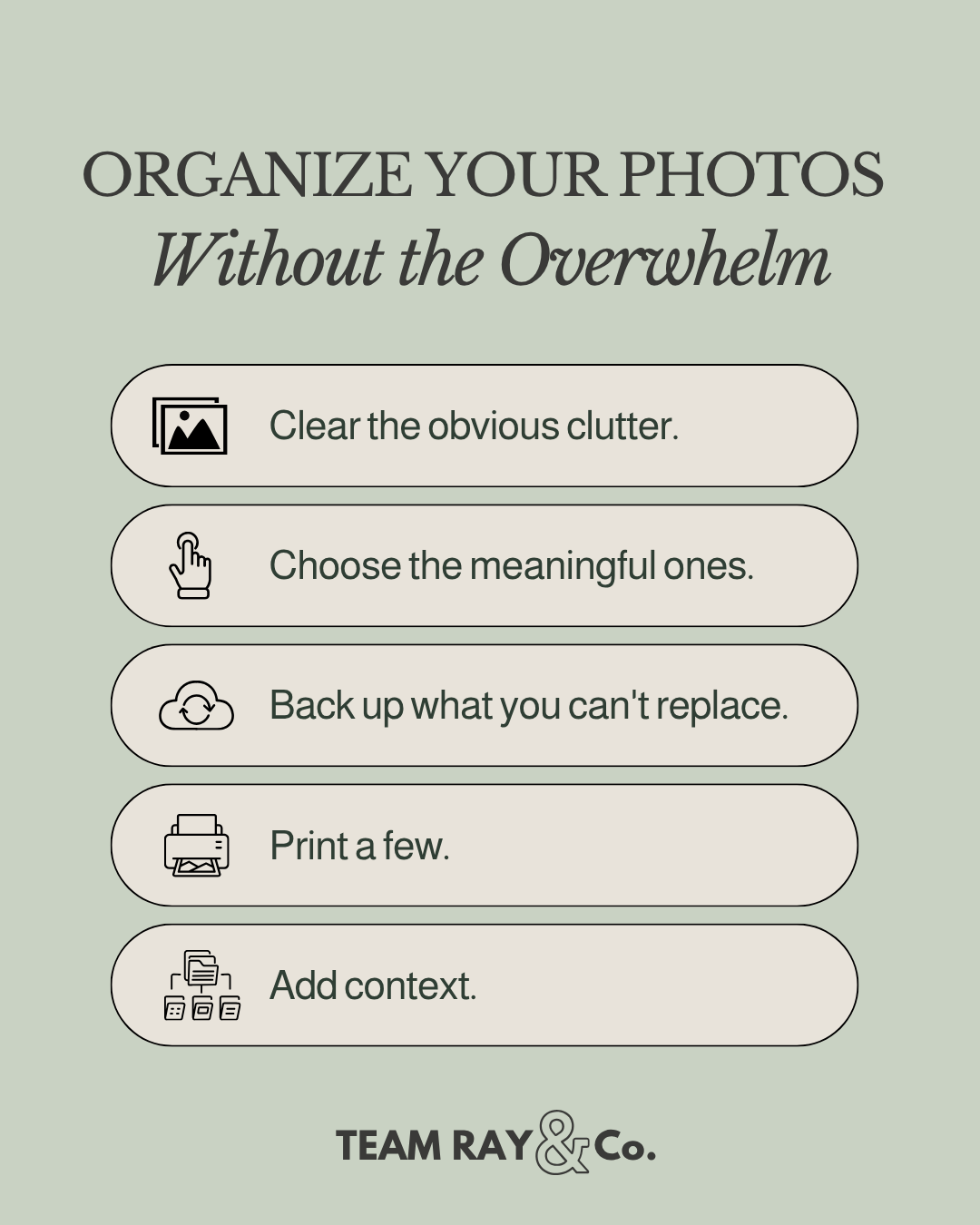
A simple process might look like this:
Clear the obvious clutter. Delete duplicates, screenshots, accidental photographs, and temporary images.
Choose the meaningful ones. Look for people, places, moments, and photographs that tell a story.
Back up what you can't replace. Use reliable storage and, when possible, keep another copy somewhere separate.
Print a few. Create an album, frame some favorites, or make a small collection from a particular season.
Add context. For especially meaningful photographs, record names, dates, places, or the story behind them.
That is enough.
You can build from there over time.
The Photographs We Almost Didn't Take
One of the strange things about photographs is that we often don't know which ones will matter until much later.
A photograph can feel ordinary when we take it.
The kitchen before the renovation. The family sitting on the porch. A grandparent holding a baby. The dog asleep in the old house. Friends gathered around a table. Someone standing in the doorway.
At the time, it is just Tuesday.
Years later, it can become the photograph that brings an entire period of life back.
That is why organizing photographs isn't only about cleaning up your phone. It is also about paying attention to what your photographs are telling you.
When you look through them, you may notice:
How many homes you've lived in
How quickly children grew
Which people appeared in your life and stayed
Which ones you lost
The places that shaped your family
The ordinary routines you didn't realize were temporary
Your photographs are quietly documenting all of it.
Let Your Home Hold Some of the Story
Our homes are already full of things that tell us who we are.
A favorite chair. A cookbook with handwritten notes. A child's artwork tucked into a drawer. A box of letters. A collection of souvenirs. A photograph on the wall.
Digital photographs can be part of that story too, but they don't have to remain invisible inside a phone. Maybe this is the year you finally print the photographs from that trip. Maybe you make an album for your children. Maybe you choose ten photographs of your parents and put them somewhere you can see them. Maybe you find the old photographs sitting on a computer and give them names so your family will know who they are someday.
Or maybe you simply spend an evening going through your camera roll and deleting the things you don't need, knowing that clearing away the clutter is also a way of making room for what matters.
We don't need to return completely to the old days of film and photo albums. But perhaps there is something worth bringing back.
The idea that a photograph is more than something we take and forget.
Some moments deserve to be chosen. Some deserve to be printed. Some deserve to be backed up carefully. And some can simply be let go.
Our phones may hold thousands of pictures, but our lives are made up of the handful of moments we would truly hate to lose.
Those are the ones worth finding again.
