

The Neighbor Test: What Would Happen If You Needed Help Tomorrow?

The Neighbor Test is a simple question: If you needed a little help tomorrow, who would you call?
Most of us like to think we could manage if something unexpected happened. We know where the important things are. We have our routines. We know how to get groceries, get to work, take care of the house, and handle the ordinary responsibilities of everyday life.
Because we can usually manage on our own, we may not think much about the people around us. We know our neighbors, see familiar faces, and exchange the occasional hello, but most days, we don't actually need anyone's help.
Until we do.
It doesn't have to be a major emergency. Maybe you're sick for a few days. Maybe your car won't start. Maybe you need someone to let the dog out, pick something up, or check on the house while you're away. Maybe you simply need someone nearby who would notice that something wasn't quite right.
These are small things, but they can become surprisingly important when you don't have anyone close enough to help.
That's what makes The Neighbor Test worth considering.
If you couldn't handle something on your own tomorrow, would you know who to call?
And perhaps just as importantly, would they know they could call you?
The People We Don't Think About Until We Need Them
There is a quiet kind of support that exists in many neighborhoods and communities.
It isn't formal. There may not be an agreement or a plan. It is simply the neighbor who brings your package inside when it rains, the friend who checks in when they haven't seen you for a few days, the person down the street who knows how to reach your family, or the relative who lives close enough to help when something unexpected comes up.
These relationships can be easy to overlook because they aren't usually part of our daily planning.
Until they are.
Sometimes the most useful question isn't, “Do I have people who care about me?” It's more practical than that: “Do the people around me know how to help if I need them?”
That distinction matters.
Someone can care deeply about you and still have no idea where your spare key is, who to call if they can't reach you, or whether you have someone nearby who can help.
Take the Neighbor Test
Imagine that tomorrow morning you wake up feeling unwell and can't leave the house.
Or imagine you have to leave town unexpectedly.
Or you realize you've locked yourself out.
Who could you contact?
It can be useful to think through a few ordinary scenarios:
Who could check on your home if you were away?
Who has a spare key, if anyone?
Who could pick up groceries, medication, or something you suddenly need?
Who could help with a pet or another everyday responsibility?
Who knows how to reach someone in your family if they can't reach you?
Who would notice if they hadn't heard from you for several days?
Who could help you get somewhere if you couldn't drive?
You may already have good answers to all of these.
But if you don't, that isn't necessarily a sign that something is wrong. It may simply mean there are a few relationships that could use a little more attention.
Independence Doesn't Mean Doing Everything Alone
We often talk about independence as though it means being completely self-sufficient.
But very few people actually live that way.
We borrow tools. We ask someone to watch the house. We accept a ride. We ask a friend to pick something up. We call a neighbor when we can't find the package that says it was delivered. We depend on family when life gets complicated.
The difference is that some people have built those connections intentionally, while others discover they need them only after something happens.
There is nothing wrong with needing people.
In fact, knowing who you can call is part of being prepared for ordinary life.
The goal isn't to create a huge network of people who are responsible for you. It is simply to know where your small circle of support exists.
Start With One Person
You don't need to suddenly become the most connected person on the block.
Start with one relationship.
Maybe there is a neighbor you've spoken to for years but never exchanged phone numbers with. Maybe a friend lives nearby. Maybe there is someone in your family you could contact more easily if you had their number saved in your phone.
A simple conversation can create a surprising amount of reassurance.
You might say, “Hey, I realized we’ve lived next door to each other for years and I don't think we even have each other's numbers.”
Or, “If you ever need someone to check on the house, feel free to call me. I'd love to be able to do the same.”
Nothing complicated. No formal arrangement. Just a small opening.
From there, relationships tend to grow naturally.
Make the Important Information Easier to Find
There is another part of the Neighbor Test that has less to do with relationships and more to do with information.
If something happened and someone needed to help you, would they know what to do?
You don't need to create a binder full of instructions. But there are a few basics worth making easy to find.
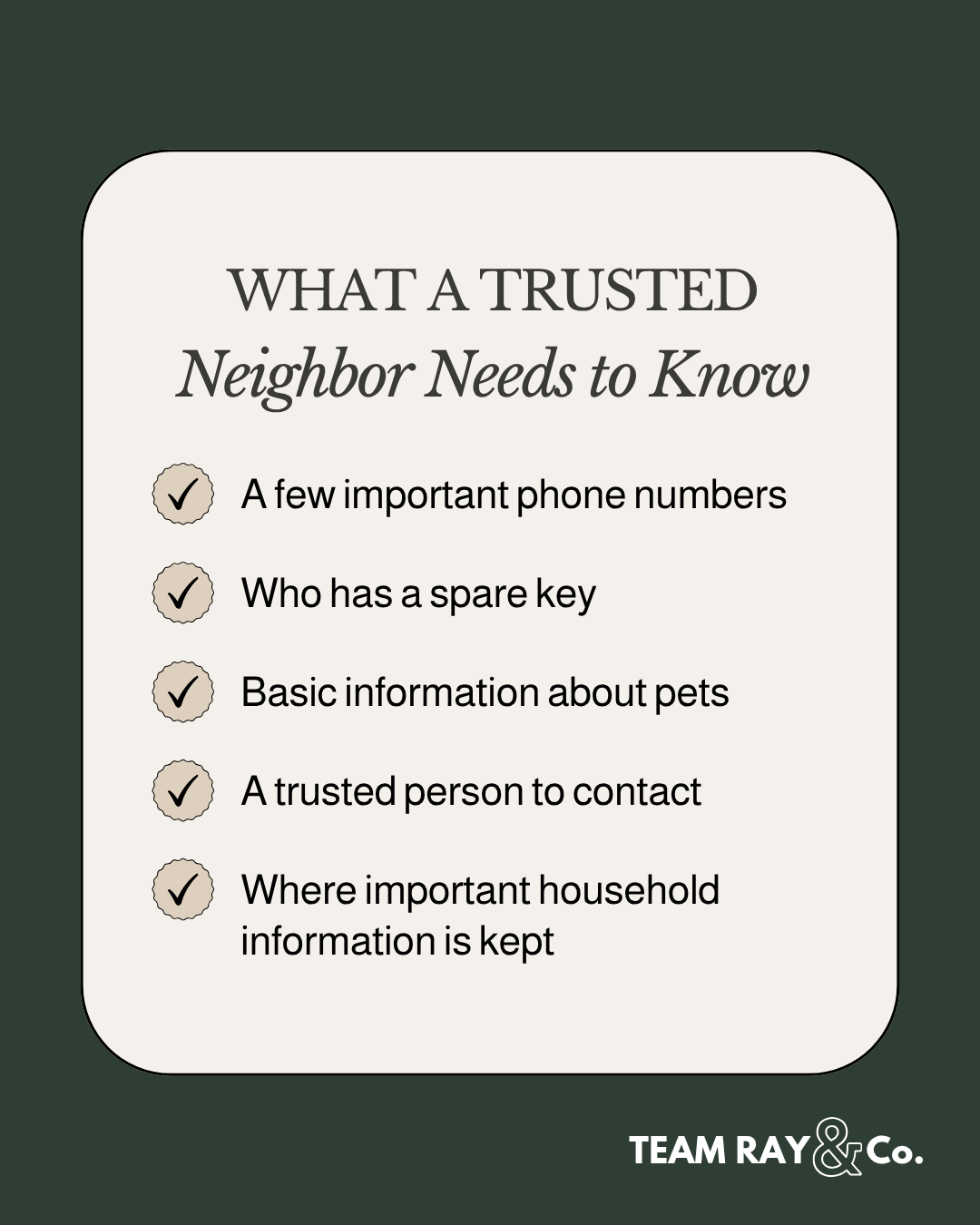
Consider keeping track of:
A few important phone numbers, including family or close friends.
Who has a spare key, if someone does.
Basic information about pets, if you have them.
A trusted person to contact if something unexpected happens.
Where important household information is kept, especially if someone might need to access it while you're away.
The point isn't to prepare for every possible scenario.
It's to remove some of the guesswork.
When people are trying to help, clear information can make a difficult situation much easier.
Community Often Starts Small
We sometimes imagine community as something large.
A neighborhood gathering. A volunteer organization. A group of people who all know each other.
But community can be much smaller than that.
It can be two neighbors who look out for each other. It can be the friend who always calls on Sunday. It can be the person who knows when you are traveling and keeps an eye on the house. It can be a few people scattered across different parts of your life who would answer if you called.
These small connections matter because life is unpredictable.
We don't know when we will be the person who needs help.
And we don't know when we will be the person someone else calls.
That is part of what makes community work. It moves in both directions.
The Question Worth Asking
The Neighbor Test isn't really about figuring out who would rescue us in a crisis. It is about noticing the relationships that already exist around us and asking whether we've given them enough room to become useful when life gets a little harder.
Who knows you well enough to notice when something is different? Who could you call without feeling like you were imposing? Who could call you? Who lives close enough to make a difference? And perhaps most importantly, who would you like to know a little better?
You don't have to build a large network. You may only need to look around and notice that you already have the beginnings of one.
Sometimes making life easier starts with something very simple: knowing that if tomorrow is harder than expected, you don't have to figure everything out by yourself.
