

The Art of Making Room: What Our Homes Teach Us About Living With Differences

The art of making room isn't only about creating physical space. Sometimes, it means learning how to make room for the people we share that space with.
A home has a funny way of revealing how different we really are. We can love the same people, share the same address, eat at the same table, and still have completely different ideas about what makes a home feel comfortable.
One person likes the house quiet in the morning. Another turns on music before they've finished their coffee. Someone feels better when everything has a place. Someone else leaves their shoes by the door, their book on the coffee table, and yesterday's mail wherever they happened to put it down.
One person wants to plan every family gathering weeks in advance. Another would happily decide what to have for dinner twenty minutes before everyone arrives.
None of these people are necessarily wrong. They're just different.
And when we share a home, those differences have a way of showing up in the smallest parts of everyday life. They shape how we use our rooms, how we organize our things, how we spend our mornings, and even what we consider peaceful, comfortable, or welcoming.
Living together doesn't require everyone to want the same things.
It requires learning how to make room for each other.
A Home Is Shared Space
We often think of home as a place that belongs to us. Our kitchen. Our living room. Our bedroom. Our routines.
But when we share a home with other people, it also becomes a place where we practice making room.
Not just physically.
Emotionally, too.
We make room for someone's early mornings and someone else's late nights. We make room for the person who needs a quiet afternoon and the person who loves having friends over. We make room for different tastes, different habits, different energy levels, different ways of communicating, and different ideas about what matters.
Sometimes this happens naturally. Sometimes it takes a little work.
The interesting thing is that the biggest disagreements at home are not always about big things. They can be about:
Dishes in the sink
The temperature of the thermostat
How loud the television should be
Whether the living room should stay tidy
Whether dinner should happen at six or whenever everyone is hungry
These little differences can become surprisingly important when they happen every day.
But they can also teach us something.
Living well together doesn't require everyone to become the same. It requires us to figure out how our differences can exist in the same space.
Not Every Difference Needs to Be Fixed
There is a certain comfort in being around people who think the way we do. They understand why something bothers us. They like the same things. They make decisions in familiar ways. We don't have to explain ourselves quite as much.
But families don't work that way for very long. People grow and change. Children become adults. Partners develop different routines. Parents and grown children discover that they don't necessarily see the world the same way. Friends become housemates. Families blend. People move in and out of our lives.
The longer we share a home with someone, the more likely we are to discover the places where our preferences don't line up. Sometimes we try to convince the other person that our way is better. Sometimes we quietly tolerate something that continues to bother us. Sometimes we avoid the conversation altogether until a small irritation becomes a much bigger argument.
But there is another option: we can ask whether the difference actually needs to be resolved.
Maybe the answer is simply to make a little room for the fact that we aren't all going to do things the same way.
The towels don't have to be folded exactly the same way. If everyone can find what they need, perhaps the method doesn't matter as much as we think.
One person can have a messy desk. As long as the shared spaces remain comfortable, a personal space doesn't necessarily need to meet someone else's standard.
Everyone doesn't have to love the same holiday traditions. A tradition can still matter deeply to one person without becoming an obligation for everyone else.
One person can listen to music while another enjoys quiet. Different preferences can sometimes coexist when everyone has a space where their needs can be respected.
Not every difference needs a solution. Some simply need a little space.
The goal isn't always to find the perfect arrangement where everyone does things the same way. Sometimes it is simply to find an arrangement that allows everyone to live comfortably, while accepting that the people sharing the home may have very different ideas about what comfortable means.
Making Room Can Look Like…
Tolerance at home rarely looks like some grand gesture. More often, it is a collection of small decisions that say, “There is room for you here, too.”
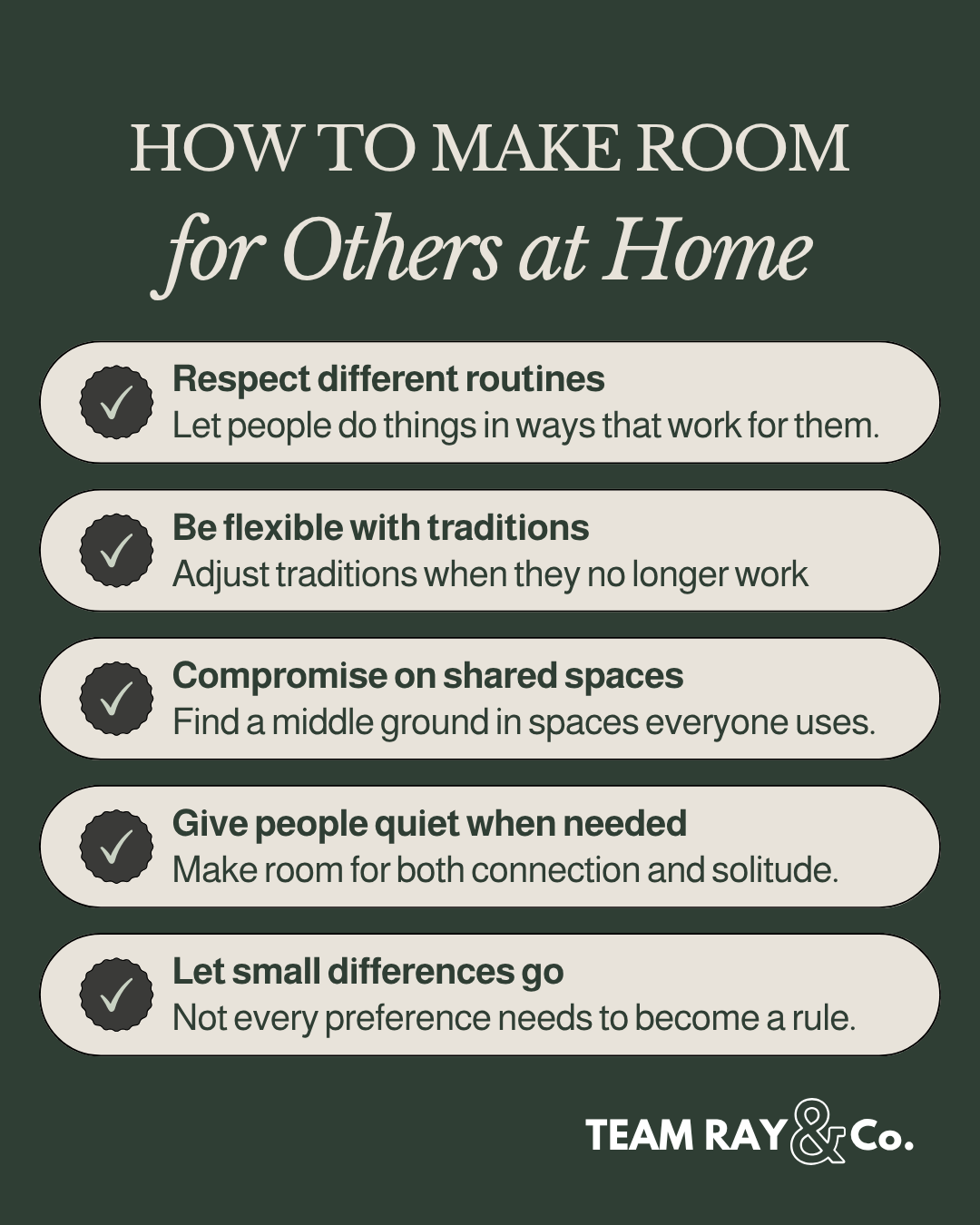
Letting someone have their own routines. Not everyone wakes up, eats, cleans, rests, or spends their free time in the same way. Familiar routines can make people feel grounded.
Accepting that not everyone enjoys the same traditions. A tradition can be meaningful to one person and exhausting to another. Sometimes changing the tradition helps preserve what was meaningful about it in the first place.
Compromising on shared spaces. Kitchens, living rooms, bathrooms, and dining tables belong to everyone who uses them. Finding a middle ground is often more useful than deciding who is right.
Giving people quiet when they need it. Some people recharge through conversation and activity. Others need solitude. Both can be valid.
Knowing which differences actually matter. Not every irritation deserves a conversation, and not every preference needs to become a household rule.
That last one may be the hardest.
Because when we live closely with someone, we see everything.
The cup left on the counter. The shoes in the hallway. The cabinet door left open. The music playing while we're trying to read.
We have opportunities all day long to decide whether something deserves our attention.
Sometimes it does.
Sometimes it really doesn't.
The Difference Between Preference and Need
One of the most useful things we can learn in a shared home is the difference between something we prefer and something we genuinely need.
You may prefer a quiet house in the evening. Someone else may prefer having the television on. Those preferences can probably be negotiated.
But perhaps one person works from home and genuinely needs a quiet place for calls. Perhaps someone has an early morning and needs to sleep. Perhaps another family member uses the kitchen at a particular time because of their schedule.
The difference matters because compromise becomes easier when we understand what is underneath the preference.
Instead of saying, “You always make too much noise,” we might say, “I have an early morning tomorrow. Would you mind keeping the volume down after ten?”
Instead of, “You are always leaving things everywhere,” we might say, “Could we keep the kitchen counter clear? I use that space every morning.”
The conversation becomes less about someone's personality and more about finding a way for two people's needs to coexist.
That is often a much easier problem to solve.
Some of the Best Homes Aren't Perfectly Aligned
There is an image of the perfect home that we see everywhere.
Everything coordinated. Every room calm. Every surface clear. Everyone somehow enjoying the same aesthetic.
Real homes are rarely like that.
Real homes have a little evidence of the people living in them.
There is the chair someone always sits in. The stack of books beside the bed. The child's artwork still on the refrigerator years later. The collection one person insists on keeping. The blanket another person refuses to replace. The kitchen drawer that somehow belongs to everyone and no one.
These things can make a home feel lived in.
And sometimes the differences are part of what makes a family interesting.
One person loves cooking. Another loves ordering takeout. Someone collects plants. Someone else doesn't understand why there are so many plants. One person wants to host every holiday. Another would rather spend the afternoon in sweatpants watching a movie.
A shared home doesn't have to erase those differences.
It can hold them.
Learning When to Bend
Compromise has a bad reputation sometimes.
It can sound like giving something up or settling for less.
But in a home, compromise can be a form of generosity.
You let someone choose the restaurant because you know they have been looking forward to it. You agree to host the family gathering even though you'd rather not because you know it matters to someone else. You give up your preferred spot on the couch. You let the kitchen be rearranged because it makes someone else's routine easier.
And sometimes someone does the same for you.
The important thing is that compromise works both ways.
If one person is always adjusting while everyone else gets exactly what they want, that isn't really making room. It is simply asking one person to shrink themselves to fit the household.
Healthy compromise leaves room for everyone.
It also requires knowing when not to compromise. There are things that touch on safety, dignity, privacy, or basic respect where a simple “meet in the middle” isn't always the right answer.
Making room for differences does not mean ignoring important boundaries.
It means learning to tell the difference between a genuine problem and a difference in preference.
When Families Gather, Differences Get Louder
This becomes especially noticeable when families come together.
Holidays, birthdays, vacations, reunions, and long weekends can put a lot of different personalities under one roof. People bring their own expectations, traditions, schedules, food preferences, opinions, and histories with them.
Someone wants the traditional meal. Someone wants to change the menu. Someone expects everyone to arrive early. Someone is always late. Someone wants to talk about everything. Someone would rather sit quietly in the corner.
These differences can make gatherings complicated, but they can also remind us that traditions are living things.
If a tradition only works when everyone behaves exactly the same way, perhaps the tradition needs some room to change.
Maybe:
Dinner starts a little later.
Someone brings a different dish.
The gathering becomes shorter.
There is a quiet room where someone can step away for a while.
Not everyone participates in every activity.
The point isn't to accommodate every possible preference.
It's to remember that the people matter more than the perfect execution of the plan.
A Little More Curiosity Helps
Sometimes tolerance begins with something very simple: becoming curious.
Instead of assuming someone is being difficult, we can ask why something matters to them.
Why does Dad care so much about having dinner at the same time every night?
Why does your sister want to keep that old tradition?
Why does your partner need the house quiet in the morning?
Why does your teenager want their room arranged completely differently from the rest of the house?
We don't have to agree with the answer.
But understanding it can change how we respond.
People often have reasons for their preferences that aren't immediately visible:
A routine may provide comfort.
A particular object may carry a memory.
A quiet room may be how someone restores themselves after a long day.
A family tradition may connect someone to people they miss.
Once we understand the reason underneath something, it can become easier to decide how much flexibility we have.
Home Teaches Us to Make Room
There is something quietly beautiful about the way a home asks us to practice living with other people.
We learn that our way isn't always the only way. We learn that some things can be shared and some things need to remain personal. We learn that sometimes we need to speak up, and sometimes we need to let something go.
We learn that making room isn't always about having more physical space. Sometimes it means making room for another person's:
Preferences
Personality
Pace
Traditions
Point of view
And perhaps the most important lesson is that tolerance doesn't mean we stop having opinions.
You can still love quiet. You can still prefer your kitchen organized a certain way. You can still have traditions that matter deeply to you. You can still disagree.
The art is learning how to hold those preferences without requiring everyone around you to adopt them.
Because a good home isn't one where everyone agrees.
It is one where people feel there is room for them.
Room to be themselves. Room to be different. Room to change their minds. Room to have a bad day. Room to keep the things that matter to them. Room to say, “This is important to me,” and trust that someone will at least try to understand why.
We spend so much of our lives learning how to make our homes comfortable.
Maybe part of that work is learning how to make them comfortable for the people we share them with, too.
Sometimes that means rearranging a room. Sometimes it means changing a tradition. Sometimes it means having a conversation.
And sometimes it simply means leaving the shoes by the door and deciding that, today, they aren't worth an argument.
