

The Things That Tell a Life Story: Why We Keep Objects That Don't Look Valuable on Paper
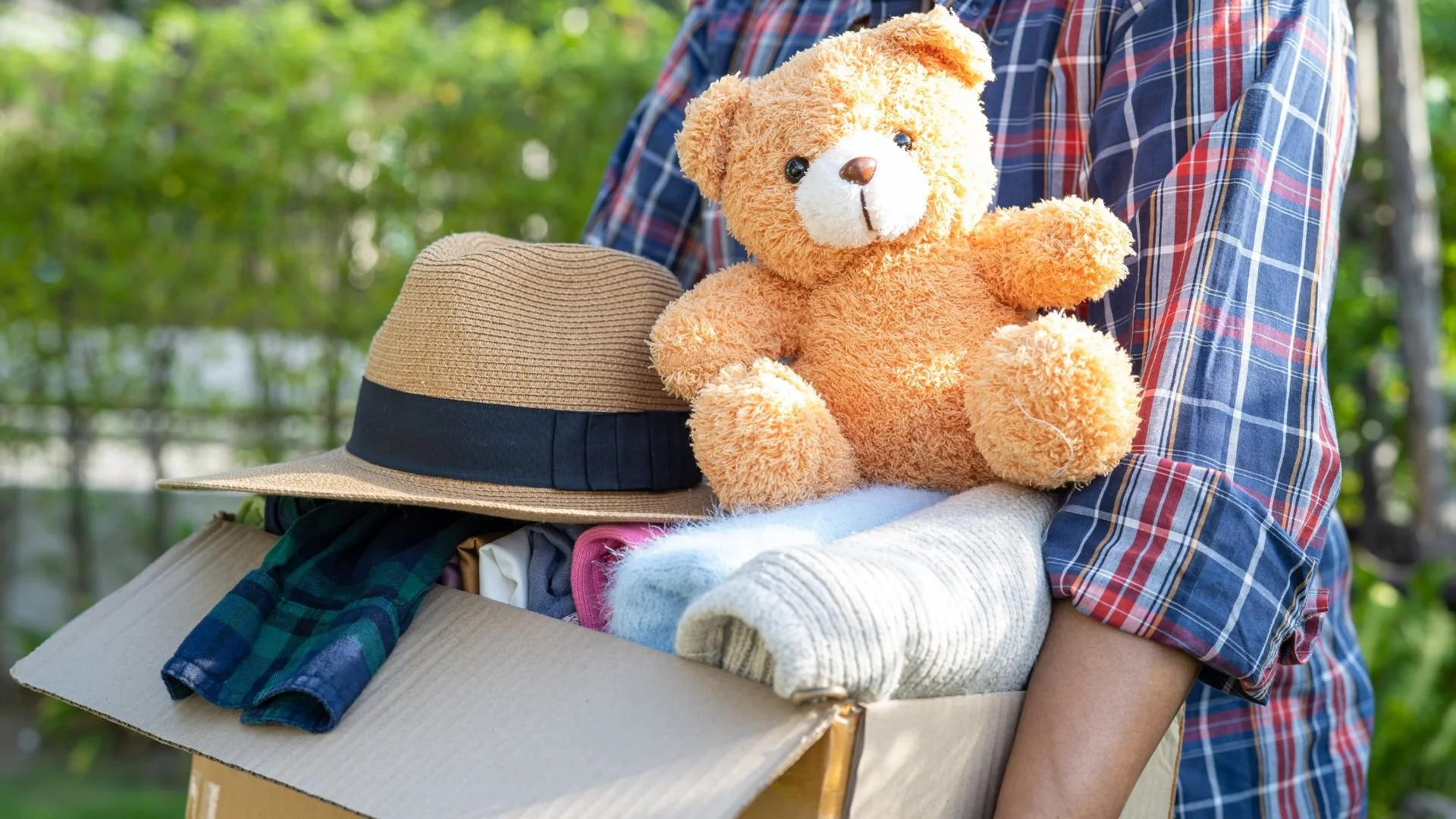
The things that tell a life story are not always the things that look valuable on paper.
In almost every home, there are objects that would seem unremarkable if someone were simply making a list of household belongings. Their monetary value may be small, and their practical purpose may have disappeared years ago. Yet they remain because they carry something that cannot be measured by a price tag.
A box of old letters. A watch that no longer works. A stack of photographs with names written on the back. A coffee mug that has been repaired more than once. A handwritten recipe card with faded corners. A uniform tucked away in a closet. A medal in a small box. A souvenir from a trip that nobody remembers the exact date of, but everyone remembers the story.
We don't necessarily keep these things because they are useful. We keep them because they mean something.
An object can hold a piece of a person. It can remind us where someone came from, what they cared about, what they did, who they loved, or what a particular season of life felt like.
Sometimes, the object itself isn't even the most important part.
It's the story attached to it.
A medal might tell us that someone served their country. A set of gardening tools might remind us of the person who was always outside on Saturday mornings. An old apron might bring back memories of holidays in a grandmother's kitchen. A watch might have belonged to a father who wore it every day for thirty years.
The object becomes a doorway into something larger than itself.
And homes are full of these doorways. They are tucked into drawers, closets, cabinets, boxes, shelves, and corners, quietly carrying pieces of the lives that came before us.
The challenge isn't simply deciding what is valuable enough to keep.
Sometimes, it's recognizing which objects are carrying a story worth remembering.
What We See, and What Someone Else Sees
One of the interesting things about family belongings is that their meaning isn't always obvious.
You may walk past a particular chair every day without thinking much about it. Someone else may see that chair and immediately remember sitting beside their grandfather. You may see an old wooden box as something that takes up space in a closet. Your sister may know that it held your mother's sewing supplies for most of her life.
This is one reason sorting through a loved one's belongings can become unexpectedly emotional. We aren't always sorting objects. We are sorting memories, relationships, and pieces of a life.
And those things don't come with price tags.
When you come across something that doesn't appear particularly valuable, it can help to ask a few different questions:
Who did this belong to?
What does it remind us of?
Is there a story attached to it?
Would someone in the family want to know where it came from?
Would we miss the story if the object disappeared?
The answers can change how we look at something.
An old tool may not be useful anymore, but the story of the person who used it may be worth keeping. A stack of letters may never be read again, but knowing that they exist may matter to someone. A uniform may spend most of its life in a storage box, but taking it out once in a while can reconnect a family with a chapter they don't want to forget.
The Things That Outlive Their Everyday Purpose
Most belongings begin with a practical purpose.
A watch tells time. A suitcase carries clothes. A recipe helps someone make dinner. A camera takes photographs. A tool fixes something around the house.
But over time, an object's purpose can change.
The watch stops being worn and becomes a reminder. The recipe becomes a family tradition. The camera becomes evidence of the places someone once went. The tools become part of the story of the person who spent years building, fixing, gardening, or making things with their hands.
This is part of what makes older homes so interesting. If you look closely, you can often see layers of a person's life sitting alongside one another.
There might be something from childhood in one drawer, something from working years in a closet, photographs from raising a family in the hallway, and souvenirs from later travels on a shelf.
A home becomes an unofficial biography.
We don't always realize we're living among these chapters until something prompts us to look.
Veterans Day is one of those moments. A uniform, service photograph, medal, flag, letter, or other keepsake can represent years of someone's life that younger family members may know very little about. The object gives us a reason to ask questions and listen to stories that might otherwise disappear.
Sometimes the most meaningful thing we can inherit is not the object itself, but the conversation it starts.
Before the Story Gets Lost
There is another reason these ordinary belongings matter: sometimes the story disappears before the object does.
A family may keep a box of photographs for decades, but eventually nobody remembers who is pictured in them. A collection of medals may remain carefully stored, while the details of the person's service become harder to recall. A handwritten recipe survives, but nobody remembers whose handwriting it was or why that particular dish was always made at Christmas.
The physical thing remains.
The context slowly disappears.
That is why it can be worth taking a little time to capture the stories while the people who know them are still around. It doesn't need to become a major family-history project. You don't need professional photographs, archival boxes, or a perfectly organized genealogy.
Sometimes a note in your phone is enough.
For meaningful objects, consider recording:
Who it belonged to
Where it came from
Approximately when it was used or received
Why the person kept it
Any story, memory, or family tradition connected to it
Who might want to have it someday
For photographs, even something as simple as “Grandpa and his brothers at the family farm, around 1965” can make a photograph much more meaningful years from now.
The goal isn't to document everything.
It's to save enough of the story that the next person doesn't have to guess.
Not Everything Has to Be Kept
There is an important part of this conversation that can be uncomfortable.
Just because something has meaning doesn't mean we have to keep everything.
A life can contain hundreds of meaningful objects. A family can accumulate decades of photographs, paperwork, clothing, souvenirs, furniture, decorations, tools, and keepsakes. Eventually, someone has to make decisions about what stays.
That doesn't mean the memories have to disappear.
Sometimes the best way to honor a life is to choose a smaller collection of things that genuinely tell its story.
A family might keep the medals but let go of the uniform that has deteriorated. Someone might photograph a collection of tools before passing most of them along. Several boxes of photographs might become a smaller album. A dozen holiday decorations might become the three that everyone remembers.
When deciding what deserves a place in the home, it can help to separate the object from the memory.
Ask:
Is the physical object important, or is the story more important?
Would a photograph preserve enough of the memory?
Does someone actually want to keep this?
Is there another family member who would appreciate having it?
Could the item be given to someone who would use or value it?
Are we keeping this because it matters, or because letting go feels difficult?
The goal isn't to preserve every object.
It is to preserve the meaning.
Passing Things Along Is Part of Keeping Them
We often think of keeping something as holding onto it ourselves.
But sometimes keeping a story means letting the object move to someone who will appreciate it.
A granddaughter may want her grandmother's recipe box. A son may want the tools his father used. Someone may treasure an old watch because they remember seeing it on a parent's wrist. A grandchild may be fascinated by photographs from a time they never experienced.
An object can become more meaningful when it has somewhere to go.
And sharing doesn't always have to happen within the immediate family. A uniform or collection of service-related items might be meaningful to a local historical organization. Old photographs might help relatives piece together a family history. Tools might be useful to someone who will actually use them.
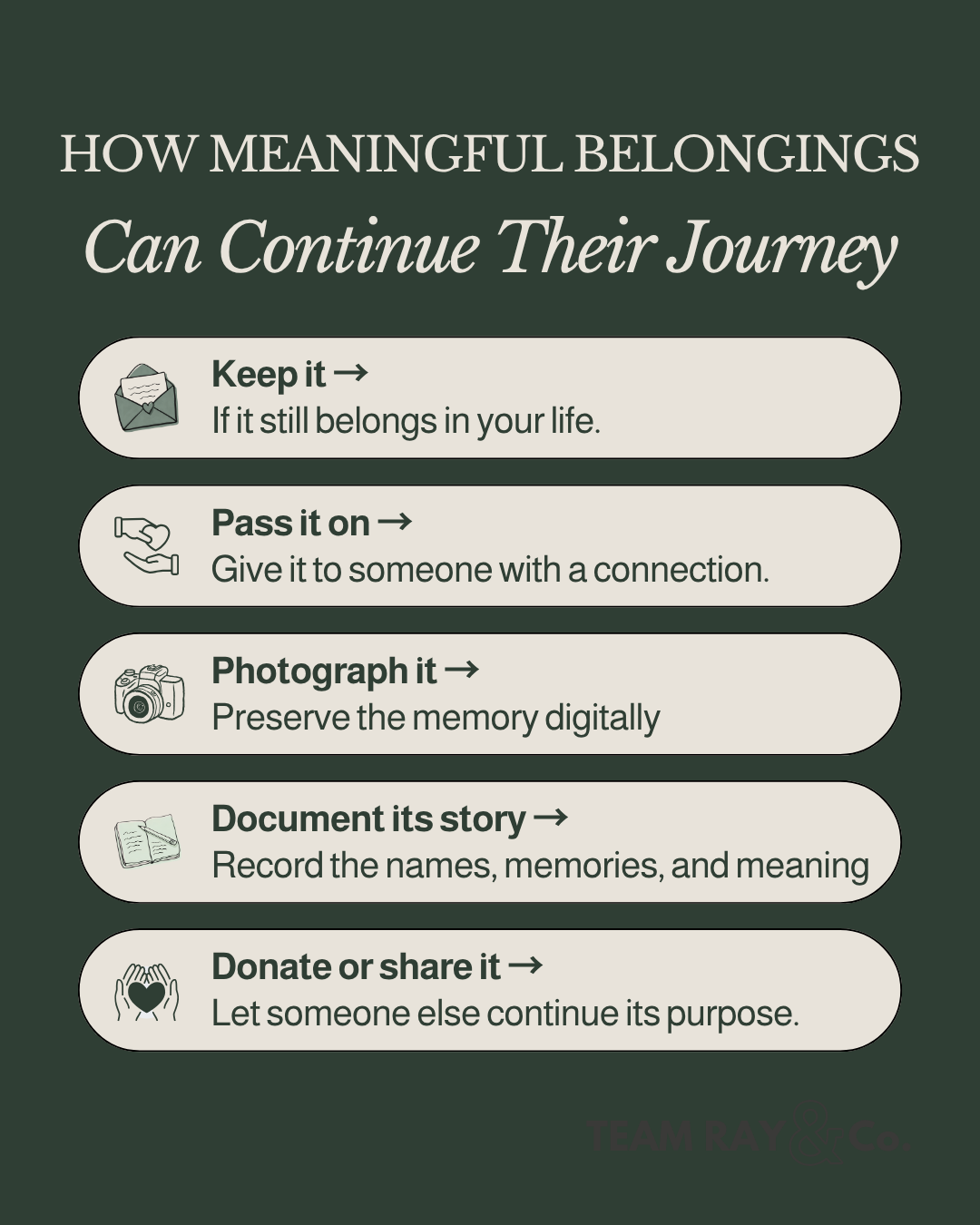
There are many ways a meaningful belonging can continue its journey:
Keep it if it still has a meaningful place in your life.
Pass it to family if someone else has a personal connection to it.
Photograph it when the story matters more than keeping the physical object.
Document it so future generations understand its significance.
Donate or share it when another person or organization may value it more than you can.
The important thing is that the story has a chance to continue.
Look Around Your Own Home
We don't have to wait until someone is gone to ask about the things they keep.
In fact, some of the best conversations happen while the person who knows the story is sitting right there.
Next time you're visiting family, look around. There may be something you've seen a hundred times but never asked about.
A photograph. A painting. A piece of furniture. A medal. A recipe card. A souvenir. A box tucked into the back of a closet.
Ask about it.
You may hear a story you've never heard before.
And while you're at it, think about the things in your own home. What would someone else know about your life if they had to understand it through your belongings?
Maybe they would find your travel souvenirs and know that you loved seeing new places. Maybe they would find a stack of handwritten notes and understand how much certain friendships meant to you. Maybe they would find a collection of cookbooks and know that feeding people was one of the ways you showed love.
Or maybe they wouldn't know much at all.
That's a good reason to leave a little context behind.
Our homes hold pieces of us, but objects don't always explain themselves.
A Life Is More Than What It Is Worth
We live in a culture that often asks what something is worth.
What is the house worth? What is the furniture worth? What could this antique sell for? Is this collection valuable? Is it worth keeping?
Those are reasonable questions.
But they aren't the only questions.
Some of the most important things in a home may have almost no financial value at all. Their value is measured in stories, memories, familiarity, and connection.
A medal may be worth little on the resale market and mean everything to a family.
A recipe written on a scrap of paper may be worth nothing financially and become one of the most treasured things a grandchild owns.
A broken watch may never work again and still be one of the first things someone reaches for when remembering their father.
This is why the process of inheriting belongings can be so complicated. We aren't simply deciding what objects deserve to survive. We're deciding which pieces of a life we want to carry forward.
And we don't always need to keep the biggest, oldest, or most expensive things.
Sometimes the smallest things tell the biggest stories.
The Stories We Choose to Carry
Perhaps that is the real gift of meaningful belongings.
They give us something tangible to hold onto, but they also remind us to look beyond the thing itself.
The old watch points to a person.
The recipe points to a kitchen.
The photograph points to a family.
The medal points to a chapter of service.
The tools point to years of work.
The letter points to a relationship.
The souvenir points to somewhere someone once stood.
A home can hold all of these stories at once.
We don't have to keep every object to remember a life. We don't have to turn our homes into museums. And we don't have to feel guilty about letting go of things that no longer have a place in our lives.
What matters is being intentional about what we carry forward.
Maybe that means keeping a small box of the things that matter most. Maybe it means making an album. Maybe it means labeling the photographs. Maybe it means sitting with a family member and asking questions while there is still time to hear the answers.
Because one day, someone else may open that drawer.
They may find the watch, the recipe, the photograph, the medal, or the old letter.
And if we've left a little of the story behind, they won't just see an object.
They'll see a life.
