

Should You Remodel Before You Sell? Here’s How We Find Out

The question sounds simple. The answer almost never is.
One of the first things homeowners ask us when preparing to sell is this:
“Should we remodel first?”
It sounds straightforward. It isn’t.
The answer depends on the home’s condition, current market dynamics, timeline, budget, and sometimes factors that have nothing to do with real estate at all.
A medical situation. A probate timeline. A job relocation. A family decision that has to happen sooner than expected.
Getting this decision wrong in either direction is expensive. Remodel when you shouldn’t, and you risk spending money and time you won’t recover. Sell as-is when targeted improvements would have made a meaningful difference, and you leave equity on the table.
That’s why at Team Ray & Co., we don’t start with a recommendation.
We start with an evaluation.
What We’re Actually Looking At
Every home starts from a different place. Some need significant work before they’re ready for buyers. Some need very little. Most are somewhere in between, and that middle ground is where the real decision-making happens.
When we evaluate a property, we’re not just looking at cosmetic condition. We’re looking at:
Deferred maintenance
Structural concerns
Functional issues
Safety considerations
Overall buyer perception
Sometimes the biggest issue isn’t the home itself. It’s presentation, clutter, outdated furnishings, or a general sense that the home hasn’t been maintained. Those are perception issues, not structural ones, and they are often fixable without major investment.
Other times, there are real infrastructure problems that should be addressed before going to market. Buyers are more informed than ever. If issues exist, they will surface. The question is whether you address them strategically upfront or react to them during negotiation.
The core question is always:
What actually matters to buyers in this specific market, for this specific home?
Sell As-Is or Remodel to Sell: Comparing Real Paths
This is the decision most homeowners need to make, but often don’t get enough clarity on before committing.
Selling as-is is a valid strategy. In the right situation, it can be the best one. It reduces disruption, avoids upfront investment, and shortens the timeline. There are buyers specifically looking for as-is opportunities, and outcomes can be stronger than expected when positioned correctly.
Remodeling to sell is also valid. But it only works when the math and timing support it.
Not every renovation produces a return. Some improvements increase buyer confidence and expand the pool of buyers. Others cost more than they recover once you factor in:
Construction costs
Permit timelines
Holding costs during the project
Market changes while work is underway
Stress and complexity of managing a project during a transition
The TV version of remodeling makes it look predictable. Real-world outcomes are not.
We help homeowners see both paths clearly before choosing either one.
Which Improvements Actually Move the Needle
One of the most common misconceptions in real estate is that all upgrades add value.
They don’t.
Some improvements materially increase buyer confidence, reduce objections, and support stronger offers. Others are purely cost with minimal return.
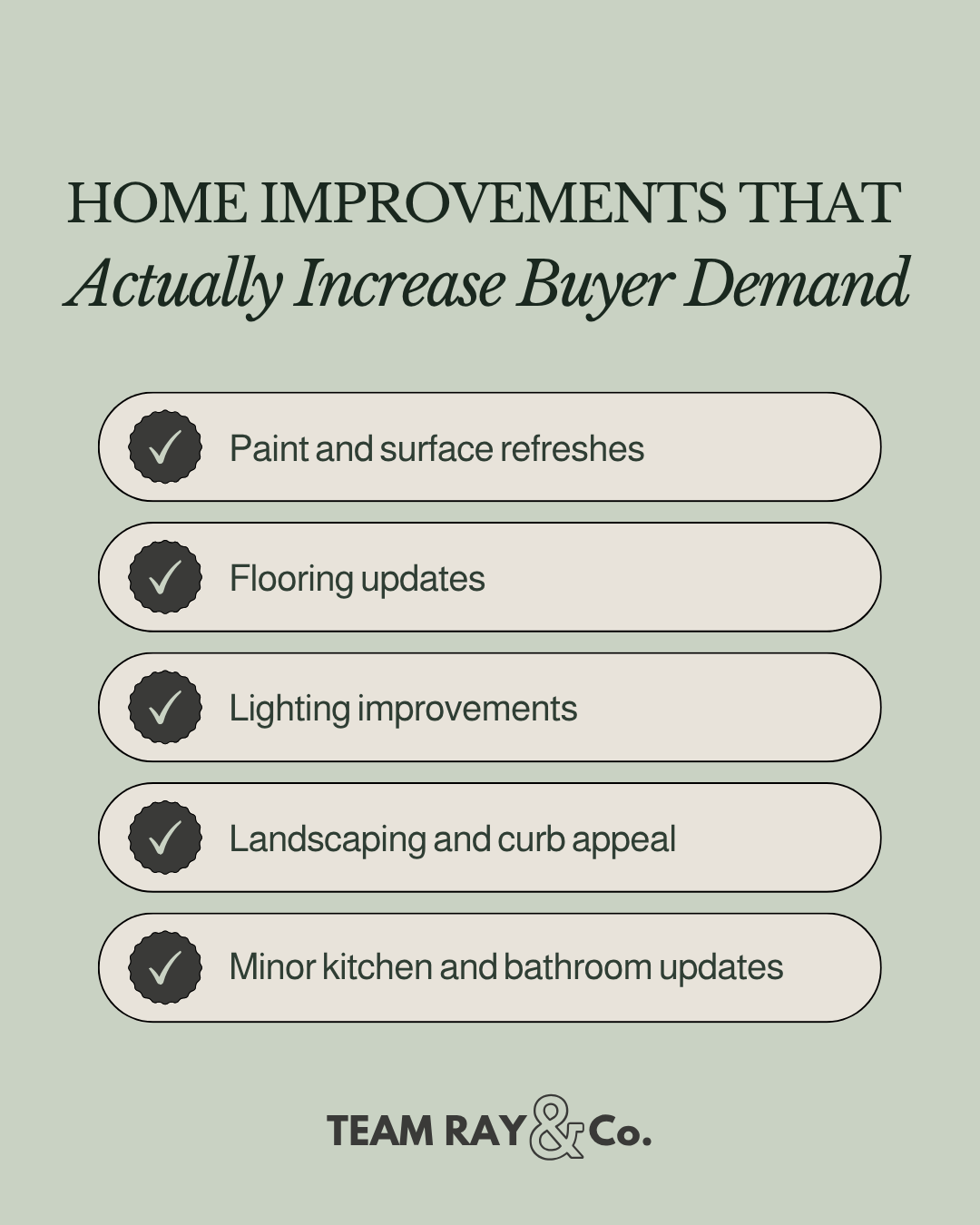
In most markets, the highest-impact improvements tend to be:
Paint and surface refreshes
Flooring updates
Lighting improvements
Landscaping and curb appeal
Minor kitchen and bathroom updates
These work because they change perception quickly without requiring major capital investment.
On the other hand, full-scale luxury remodels rarely make sense unless the home is already positioned in a price tier that supports that level of finish.
The goal is not to create a perfect home.
The goal is to create a competitive one.
Timeline Is Part of the Equation
Timing is often just as important as money.
Many homeowners don’t have the flexibility to wait through a full renovation process. Life events don’t pause for construction schedules.
A remodel might take months once you include:
Design and planning
Permitting
Contractor scheduling
Material lead times
Unexpected delays
During that time, carrying costs continue, and life doesn’t stop.
Sometimes the better financial outcome is not the higher sale price. It’s the faster, cleaner path to completion with less disruption.
We factor all of that into the decision.
The Part People Underestimate Most
A renovation doesn’t happen in isolation. It runs alongside everything else happening in life.
Families preparing to sell are often also managing:
Cleaning and downsizing
Estate or probate responsibilities
Relocation planning
Emotional decisions tied to a long-term home
Coordination with multiple service providers
Adding a construction project into that mix changes the entire experience.
At Team Ray & Co., we also help coordinate the support systems around the decision. Through our network of trusted vendors and professionals, families can access help with clean-outs, estate services, preparation work, and logistics that often become overwhelming on their own.
The goal is not just to evaluate the home.
It’s to reduce friction across the entire process.
There Is No Universal Right Answer
Some homeowners want to maximize price. Others want to minimize disruption. Others need to move quickly. Others are dealing with layered family, financial, or emotional circumstances.
All of those situations are valid.
That’s why we start with an Opportunity Analysis before any decision is made.
Not to push renovation.
Not to push selling.
But to clearly map out what each path actually looks like in reality, so decisions are made with full visibility instead of guesswork.
Because the right answer is rarely “always remodel” or “never remodel.”
The right answer is:
What actually makes the most sense for this home, in this market, at this moment in time.
