

Seattle Permit & Labor Costs: What Homeowners Should Expect in 2026
The numbers nobody puts in the brochure
Seattle is one of the most expensive construction markets in the country.
That’s not an opinion. It’s the baseline reality every homeowner needs to understand before committing to a remodel, addition, DADU, or any project that requires permits and licensed contractors.
And the expensive part isn’t just materials or labor. It’s the full stack of costs most homeowners don’t see coming until they’re already in it: permits, inspections, plan review timelines, compliance requirements, and the carrying costs that build while the project waits for approval.
In many cases, these hidden costs matter as much as the construction itself.
What permits actually cost in Seattle right now
Permits are not just paperwork. They shape timeline, contractor scheduling, sequencing, and overall feasibility.
In 2026, Seattle permit costs continue to reflect higher operational and staffing requirements at the Seattle Department of Construction and Inspections.
Many residential permit categories have increased by roughly 18% year over year. That shift is large enough to materially affect project budgets, not just line items.
Permitting isn't always a simple flat fee. Seattle's permitting process includes hourly charges for some review services, with many reviews billed at $292 per hour and certain land use reviews charged at $551 per hour. While not every project incurs significant hourly review costs, larger or more complex renovations may require multiple review cycles, corrections, and additional staff time, increasing the total cost of obtaining approvals.
To give real-world context:
A 500 sq. ft. DADU plan review and permit fee may run around $3,453
A 1,500 sq. ft. single-family addition permit may run around $6,853
These figures do not include engineering, utility coordination, surveying, tree review fees, or contractor administrative costs.
For smaller scopes, Seattle’s over-the-counter (OTC) permits can reduce both cost and timeline:
For straightforward electrical or plumbing work, OTC permitting can significantly reduce friction compared to full plan review processes.
What labor actually costs in Seattle right now
Permits are only one part of the equation.
Labor is often the largest and most variable cost driver.
Seattle’s labor market remains among the most expensive in the Pacific Northwest, influenced by cost of living, licensing requirements, insurance, and ongoing skilled labor shortages.
Typical ranges include:
Licensed trades (electric, plumbing, HVAC, structural): often $120–$200+ per hour
These figures increase once contractor overhead, insurance, project management, and coordination costs are included.
Older Seattle homes add another layer of unpredictability. Once work begins, it is common to uncover:
Outdated wiring
Non-compliant plumbing
Structural inconsistencies
Previous unpermitted work
Each discovery can shift scope, timeline, and budget quickly.
Overall construction labor costs in Seattle remain approximately 6.5% higher than prior years, keeping the market well above national averages.
The timeline costs nobody budgets for
This is where many projects become more expensive than expected.
Homeowners often focus on construction pricing and underestimate the cost of time.
Seattle’s permitting system involves multi-department review, revision cycles, and queue delays that can extend timelines significantly depending on project complexity.
Even with improved tracking tools and visibility systems, delays remain part of the process. Visibility does not eliminate waiting time.
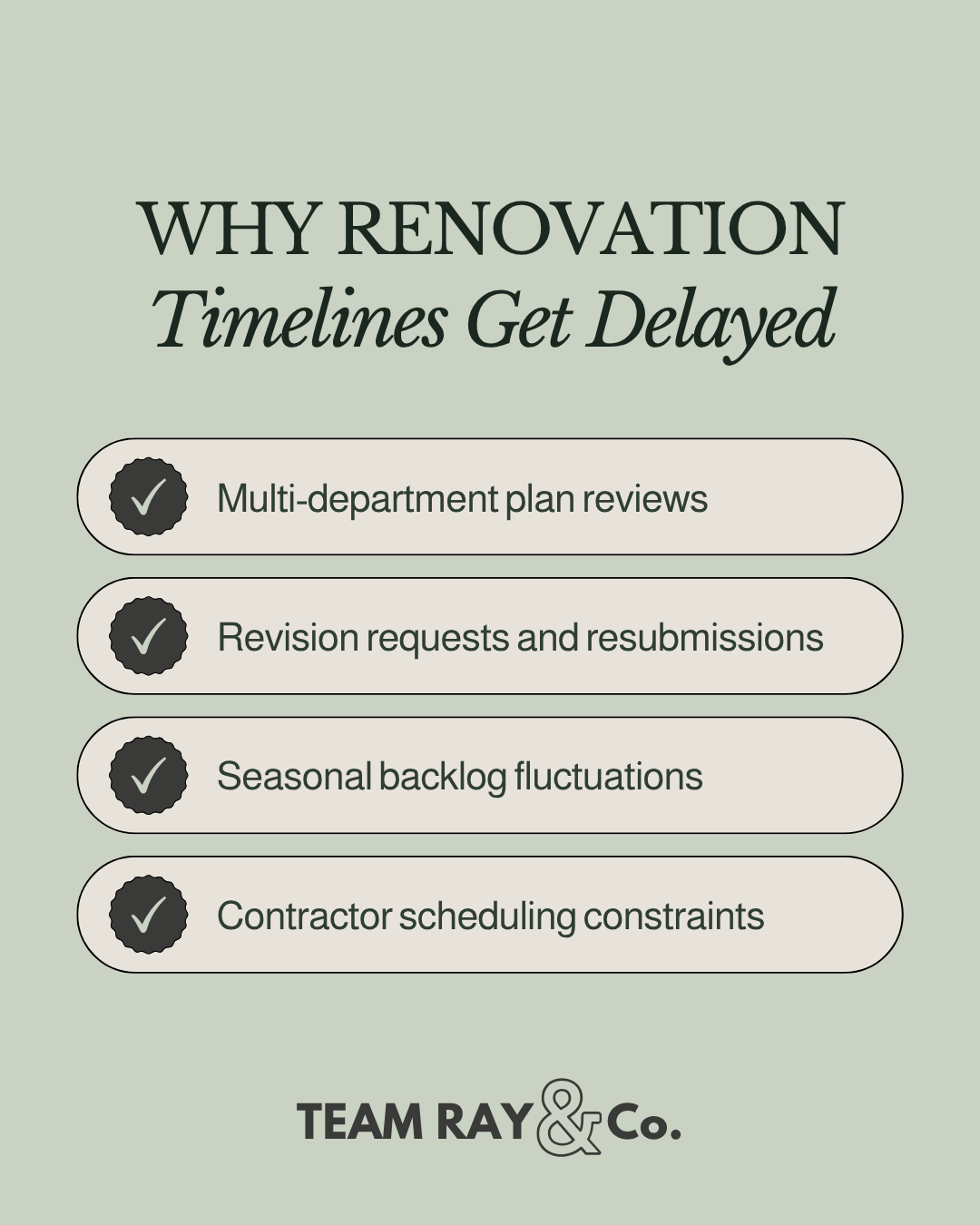
For larger remodels and additions, delays are often driven by:
Multi-department plan review cycles
Revision requests and resubmissions
Seasonal backlog fluctuations
Contractor scheduling constraints
Every week of delay has a financial impact:
Mortgage and property tax carrying costs
Utilities on vacant or partially used homes
Temporary housing or storage
Contractor remobilization fees
Financing extensions
These costs rarely appear in the original bid but can materially affect total project expense.
Site conditions can also extend timelines further. Tree protection requirements, arborist reports, and site restrictions may impact design and feasibility earlier than many homeowners expect.
Where strategic planning actually saves money
Despite high costs, not all spending is unavoidable.
One of the most important financial advantages in Seattle construction is knowing when to reduce scope rather than expand it.
Over-renovation is one of the most common mistakes homeowners make. Not every project needs structural changes. Not every home benefits from a full remodel. And not every upgrade produces proportional return.
In many cases, targeted improvements outperform full renovations, especially for:
Pre-sale preparation
Value-focused remodels
Cosmetic refresh projects
Functional repairs that unlock buyer confidence
In some eligible cases, OTC permitting pathways can also reduce both cost and timeline when scope allows.
Seattle also offers incentives for certain seismic retrofit projects, which can reduce costs for structural safety improvements in qualifying homes.
The question worth asking before anything else
In Seattle’s 2026 market, the most expensive mistake is often not the renovation itself.
It’s the decision to renovate without full clarity on total cost.
Permit expenses, labor premiums, timeline uncertainty, and carrying costs all combine to change the real economics of a project.
The projects that perform best financially are almost always the ones where someone stepped back and evaluated the full picture first.
Not just: “Can we remodel this?”
But: Should we remodel this, given the full cost, timeline, and expected return in this market?
Where Team Ray & Co. fits in
At Team Ray & Co., we help homeowners evaluate that decision before major commitments are made.
Through an Opportunity Analysis approach, we assess:
Whether a renovation improves net financial outcome
Whether selling as-is produces a stronger result
How permit, labor, and timeline costs impact total strategy
Which improvements (if any) are actually worth pursuing
Because in a market like Seattle, the most important decision is not what to build.
It’s whether building is the right financial move at all.
