

The Space In Between: Navigating Life's Most Overlooked Transition

There's a moment that doesn't get talked about enough.
It happens quietly. Maybe during a Sunday visit when you notice your mom moving a little slower through the hallway she's walked for thirty years. Or when your dad jokes about the upstairs bedroom being "too much trouble" but you both laugh it off. Or when a bill goes unopened on the counter for a week, and neither of you says anything about it.
It's the moment a home is no longer just a home. But not yet something anyone is ready to let go of.
It doesn't have a name, really. It's not a crisis. It's not a plan. It's the in-between.
And I see it all the time.
In the families I work with, especially when seniors are involved, this season is more common than people realize and far more tender than any real estate conversation tends to acknowledge. There's so much happening beneath the surface: love, fear, grief, identity, and the quiet rearranging of roles that no one prepared you for.
This isn't just a real estate event. It's a life transition. And it deserves to be treated like one.
When a Home Becomes Something Else
More Than Four Walls
A home isn't just a structure. It's a story.
It's the kitchen where your mother made her arroz caldo every Sunday morning. It's the backyard where your kids learned to ride their bikes. It's the chair by the window where your father read tgmthe newspaper for decades. It's decades of small rituals, stacked quietly on top of each other, until the house itself becomes the person living inside it.
This is why letting go is never just physical.
When a senior starts to think about leaving a longtime home, they're not just sorting through furniture and deciding what fits in the next place. They're sorting through themselves. Their routines. Their memories. Their sense of who they are and what their life has meant.
To rush that process, to move too fast toward the transaction, is to miss the point entirely.
The home holds everything. And anything that holds everything deserves to be released with care.
Recognizing the "In-Between" Stage
Most families don't realize they've already entered this transition. There's rarely a single defining moment. It usually creeps in slowly, in the small things:
Subtle shifts in daily routine. A parent stops cooking the way they used to. Social outings become less frequent. Energy that was once effortless now requires planning.
Safety or mobility concerns. Stairs become a negotiation. The bathroom feels less safe. A minor fall happens, and everyone quietly absorbs its meaning.
Conversations being avoided. Questions about "what comes next" get deflected with humor or subject changes. A silence forms around the thing everyone is thinking.
Growing involvement of adult children. Grocery runs become regular. Doctor's appointments need coordination. The balance of care quietly shifts without anyone formally deciding it would.
These aren't emergencies. But they are signals. And the families who navigate this transition most gracefully are usually the ones who started paying attention before the urgency hit.
What's Really Happening Beneath the Surface
It's Not Just a Sale. It's a Life Transition.
Here's what I've learned after years of working with seniors and their families: the real estate part is almost never the hardest part.
Pricing a home, preparing it for market, coordinating a timeline — those are logistics. Complicated, yes. But manageable.
What's harder is everything underneath:
The grief of leaving a place that holds your whole life
The fear of what independence means in the next chapter
The unspoken worry about being a burden
The adult child who doesn't know how to help without overstepping
The family members who disagree about what "the right move" even is
These emotional layers don't disappear because there's a transaction to manage. They show up in the transaction, in the delays, the second-guessing, the tension between siblings, the seller who backs out at the last minute because they just weren't ready.
When we treat a senior home transition as purely a real estate event, we miss what's actually happening. And we lose the chance to do something truly meaningful.
The Complexity of Role Reversals
There's a particular kind of grief that comes with this season that rarely gets named: the grief of role reversal.
The parent who once made all the decisions now needs their adult child's help making them. The child who was protected now becomes the one providing protection. The dynamic that organized the family for decades quietly rearranges itself, and nobody knows quite how to stand in the new configuration.
For adult children, this often feels like:
Carrying the weight of research and logistics while also processing your own feelings
Trying to honor your parent's independence while genuinely worrying about their safety
Managing disagreements between siblings who all love the same person but have different ideas about what's best
Feeling guilty for every thought that sounds like "this needs to happen soon"
For seniors, it can feel like:
Loss of control over a home they built and maintained for decades
Fear that accepting help means losing autonomy
Pressure to make big decisions while still in grief or physical transition
Uncertainty about whether the next place will ever really feel like home
Both experiences are real. Both deserve space. And a good guide knows how to hold them both at the same time.
The Rise of Multigenerational Living
A Growing Shift in Modern Families
Something beautiful is happening across the country, and it's accelerating.
Families are coming back together.
As the baby boomer generation ages, we're seeing more adult children step in, not just as coordinators from a distance, but as housemates, as daily companions, as the ones who share walls and dinners and the ordinary texture of life.
For many cultures, Filipino, Latino, Vietnamese, and so many others, this was never a departure. It was always the way. The idea that elders live separately, that independence means distance, was never the norm. And now, even in families where that wasn't the tradition, something is shifting.
People are remembering something: proximity heals.
It also creates complexity. But the movement toward multigenerational living is, at its core, a deeply human impulse. To care for the people we love. To not outsource that to strangers and facilities when we don't have to.
The Opportunities and Challenges
Multigenerational living, when it works, is genuinely beautiful.
What makes it work:
Shared support that distributes the caregiving load more fairly
Children growing up with daily access to grandparents, and everything that comes with that
Elders remaining engaged, needed, and woven into daily life rather than set apart from it
Financial breathing room that allows families to save, invest, or simply stress less
But living in close proximity also surfaces everything. The unresolved. The unspoken. The patterns that were easy to avoid when everyone lived twenty minutes apart.
What makes it challenging:
Privacy and boundaries. Whose home is it, really? Who makes the decisions? How do you love each other without losing yourself?
Space and layout. Not every home is built for this. Finding a property that genuinely supports multiple generations, with thoughtful separation and shared space, is its own search.
Emotional adjustments. Old family dynamics don't disappear just because everyone agreed to try this. They move in too.
Shared nervous systems are real. When one person in the home is grieving, anxious, or overwhelmed, the whole household feels it. That's not a flaw. It's how humans work. But it means everyone needs to go in with eyes open.
How to Navigate Senior Transition Thoughtfully
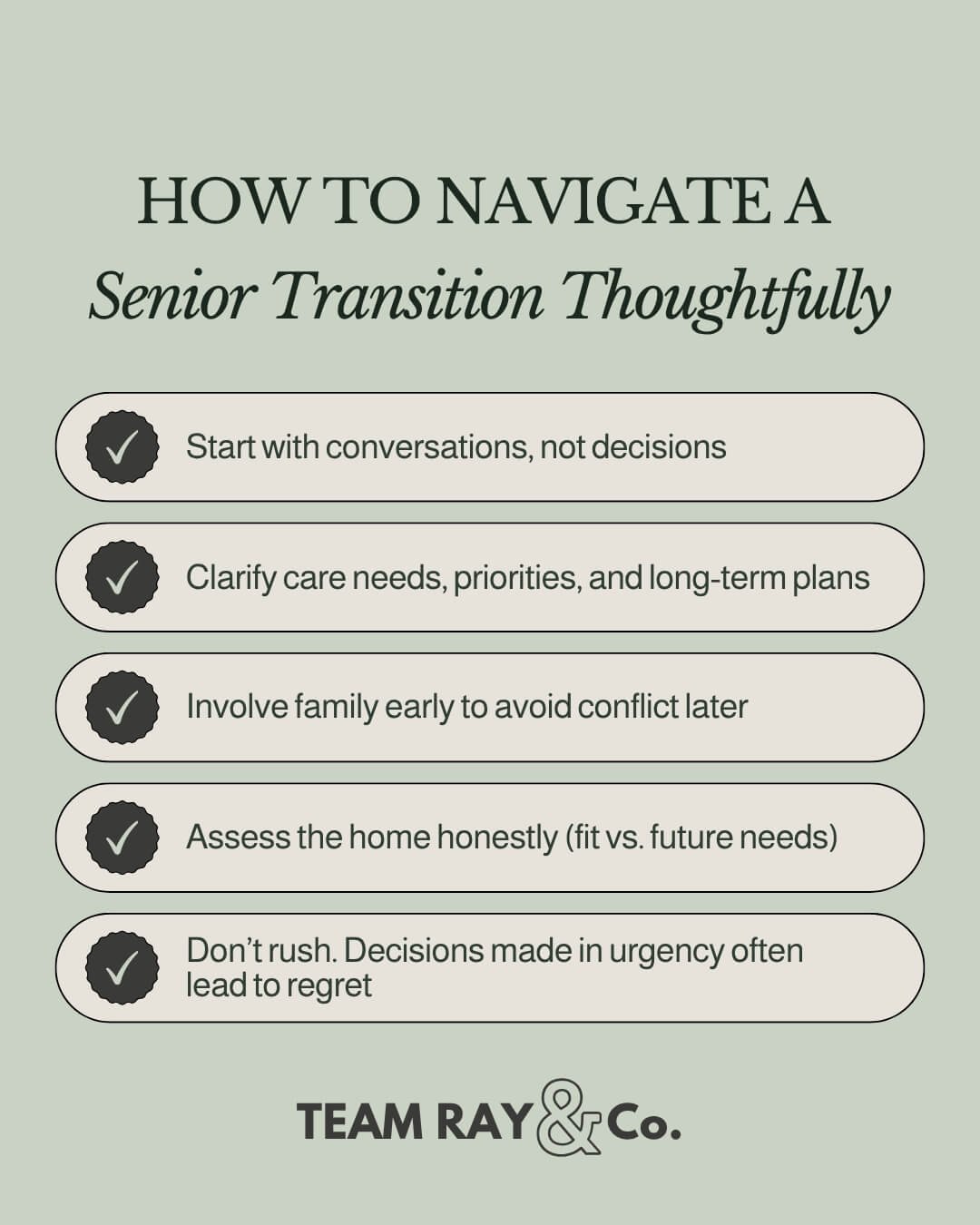
Start With Conversations, Not Decisions
The biggest mistake families make? Skipping straight to decisions before anyone has had a real conversation.
They start researching listings before the senior has processed the idea of leaving. They move fast because urgency feels like progress, and then wonder why there's tension and resistance at every step.
Before talking about what to sell or where to move, make space for the harder questions:
What does this home mean to you?
What are you most afraid of losing?
What does a good next chapter actually look like, for you, not for us?
What do you need to feel safe making this decision?
The answers to those questions will shape everything that comes after. And taking the time to ask them, really ask them, is an act of love.
Practical Tips for Families
Once the conversation has opened, here's how to move through the practical side with intention:
Clarify priorities before anything else:
What level of care does your loved one need now, and realistically, in two to five years?
How important is independence to them, and what does independence actually mean in their terms?
What are the financial parameters? What's sustainable long-term?
Assess the home honestly:
Can the current home be adapted with grab bars, single-floor living, accessibility modifications, or is it fundamentally not built for this season?
If multigenerational living is being considered, does the new home have genuine separation? A separate entrance, a kitchenette, real privacy?
Involve everyone early:
Don't let one adult child carry this alone. Even difficult family conversations are better than silent resentments.
If there are disagreements, name them early rather than letting them fester into last-minute conflict.
Plan for what's next, not just what's now:
The right decision today should still make sense two years from now.
Build in flexibility wherever possible.
Avoiding Common Mistakes
These are the patterns I see most often, and they're all understandable, which is why they're worth naming:
Rushing because the situation feels urgent. Urgency is real sometimes. But urgency plus unprocessed emotion is a recipe for decisions people regret. Slow down wherever you possibly can.
Focusing only on price or property. The "best deal" on paper can be the wrong fit in practice. A home that doesn't support the family's actual needs isn't a bargain.
Ignoring emotional readiness. A senior who isn't ready to leave will find a thousand ways to delay or derail the process. That's not stubbornness. It's grief. Meet it there first.
A Real Story: Walking With a Family Through Change
Letting Go of a Long-Time Home
Recently, I had the privilege of helping a senior client sell a home she had lived in for many years.
Walking through her rooms, you could feel the decades. Every corner held something: a grandchild's heights marked on the doorframe, a kitchen that had fed hundreds of Sunday meals, a garden she had kept alive through every season.
She was ready, mostly. But ready doesn't mean without grief. She cried a few times during the process. She needed more time at certain moments. She needed someone to acknowledge what was being released, not just to calculate what was being gained.
We didn't rush her. We paced the process to match where she actually was, not where the market said she should be. And when the right moment came, she was able to let go with dignity and not with regret.
Finding What Comes Next
Once the sale was behind her, the real question emerged: not where to move, but what kind of life to move into.
She and her adult children and I are still in that part of the process together. We're not just looking at square footage and location. We're asking: What does she need to feel supported? What do her children need to feel at peace? How do we build something that works for all of them, not just right now, but as needs continue to evolve?
That's a different conversation than a standard home search. It requires listening more than presenting. It requires holding the whole family, not just the transaction.
And it's exactly the kind of work this season calls for.
What Senior Home Partners Was Built For
Born From a Real Need
My husband Brian and I didn't set out to build a senior transition program. We set out to genuinely care for our clients.
But over time, we kept seeing the same thing: families navigating one of the most significant seasons of their lives with very little support. Adult children trying to coordinate everything, carrying the logistics and the grief at the same time, often without a clear next step or anyone to call who understood the whole picture.
So we built something to address exactly that. Senior Home Partners exists for the children of aging parents who are doing their best to show up for their loved ones and need a trusted partner to help them do it well.
What We Actually Do
We're real estate specialists, yes. But that's not the whole story.
What we really do is walk alongside families through the senior transition journey, from the first hard conversation to the moment everyone finally exhales on the other side.
That looks different for every family. For some, it starts with preparing a parent's home for sale, thoughtfully, at a pace that honors what the home has meant. For others, it means connecting families to trusted local resources they didn't know existed. For many, it simply starts with a conversation.
Here's what matters to us most:
Listening to understand, not just to respond. Your story, your fears, your family's specific dynamics — those guide everything we do.
Connecting you to the right people. We've built a network of trusted local experts across elder care, financial planning, home modifications, and more. You don't have to find them alone.
Staying in it with you. This isn't a one-call service. We're present throughout the process, available when things come up, and committed to the long view.
Keeping it free. Our services to families cost nothing. We believe care shouldn't come with a price tag.
The Vision Behind It
We call our north star "No Regrets."
It's simple, really. We want every adult child of an aging parent to be able to look back on this season and know they did everything they could. That they had the right support. That their loved one was treated with dignity. That the decisions made were informed, not rushed.
That's what we're working toward with every family we serve.
Why Guidance Matters in Seasons Like This
The Difference Between a Transaction and True Support
There are a lot of real estate agents who can help a senior sell a home.
What families in this season actually need is someone who understands what's really happening and who knows how to hold both the strategy and the sensitivity at the same time.
Someone who won't rush them toward a decision they're not ready for. Someone who can coordinate the logistics, the timing, the staging, the paperwork, while also creating space for the emotional weight of the process. Someone who knows that the goal isn't a closed deal. It's a family that lands well on the other side.
That's the standard we hold ourselves to with every client we work with.
What Thoughtful Guidance Looks Like
In practice, it means:
Slowing down when the situation calls for it, even when the market doesn't want to wait
Holding the whole family, not just the seller, because these decisions rarely affect just one person
Connecting families to the right resources, because real estate is just one piece of a much larger puzzle
Being honest about what we see, even when it's not what someone wants to hear
Staying in it for the long haul, because transitions like this don't end at closing
Creating Space for These Conversations
The Power of Community
At our recent Hearts Gathering, over 100 people showed up. Not for a listing presentation. Not for market data. They came to connect. To listen. To be in the room with other people navigating similar questions about family, care, legacy, and what comes next.
People stayed long after they needed to. They found each other in conversation and realized they weren't alone in what they were carrying.
That room told me something I've been feeling for a long time: people don't just want services. They want to be seen in their real moments.
You're Not Alone in This
If you're in this season right now, if you recognize the in-between, I want you to know something:
What you're feeling makes sense.
The weight of it is real. The love underneath it is real. The uncertainty is normal. The grief is appropriate.
And you don't have to figure it out alone.
Whether you're a senior wondering what your next chapter looks like, or an adult child trying to support a parent while managing your own life, this is navigable. With the right support, the right pace, and the right people around you, it is possible to move through this with grace.
Honoring What Was, While Preparing for What's Next
The in-between is not a problem to be solved.
It's a season to be moved through.
With intention. With patience. With honesty about what everyone needs and what everyone is letting go of.
The best transitions aren't the fastest ones. They're the ones where the people involved feel seen, supported, and ready for what's coming. Where the past is honored before it's released. Where the next chapter feels like something to move toward, rather than something to escape to.
That's the kind of transition we're committed to helping families experience. Not just a closed deal, but a real, dignified, well-supported passage into something new.
If This Feels Familiar, Let's Talk
If you or someone you love is starting to feel the pull of this season, even if it's just a quiet feeling that something needs to change, we'd love to be a resource.
You don't need to have it figured out. You don't need to be "ready." You just need to be willing to start the conversation.
That's where everything begins.
Reach out whenever you're ready. We're here, not just to help move a home, but to support the people inside of it.
