

Spring Decluttering: Making Space for What’s Next

There is something about spring that changes how we see our homes.
The light is brighter. The air feels fresher. Windows open more often. And suddenly, we notice what winter allowed us to ignore, the pile of shoes by the door, toys spilling into walkways, coats that no longer fit, paperwork stacking up on the counter.
For families, especially mothers with little ones, clutter doesn’t just look messy. It slows down mornings. It makes transitions harder. It adds quiet stress to already full days.
Spring decluttering isn’t about creating a picture-perfect home.
It’s about creating breathing room for your family’s next season.
And you do not have to finish everything in one day.
Welcoming Spring: What This Season Really Invites
Spring brings transition.
Heavier clothes get packed away. Outdoor play increases. School routines shift. Schedules fill up. Energy changes.
This is the ideal time to:
Rotate wardrobes
Reset common areas
Reevaluate storage systems
Simplify daily routines
Think of spring decluttering not as “deep cleaning,” but as preparing your home to function better for the months ahead.
Ask yourself:
What will our daily life look like in the next 3–4 months?
Your decluttering decisions should support that answer.
Where You Should Start
When motivation hits in spring, it’s tempting to start pulling everything out at once.
Don’t.
The key to sustainable decluttering is starting where it makes the biggest daily impact, not where it looks the most impressive.
Begin with spaces that:
Affect your morning routine
Disrupt transitions (leaving the house, bedtime, meals)
Visually overwhelm you every day
Avoid attics, garages, or storage closets first. Those can wait. Start where you live.
A good rule:
If you touch it every day, declutter it first.
For most households, that means:
The entryway
The kitchen counters
The living room surfaces
The primary bathroom
When these areas feel lighter, your entire home feels more manageable, even if nothing else has changed yet.
Where Families Should Start (Hint: Not the Closets)
When you have young children, start with the spaces that affect daily flow the most.
1. The Entryway
This is one of the highest traffic areas in a family home.
Look for:
Outgrown shoes
Winter boots that can be stored away
Broken umbrellas
Random bags that don’t belong
Action steps:
Store winter gear in labeled bins.
Keep only 1–2 pairs of current shoes per person accessible.
Create a simple basket for each child for quick drop-offs.
A clear entryway makes mornings smoother and afternoons less chaotic.
2. The Living Room
This space often becomes the “everything” room.
Look for:
Toys that are broken or missing pieces
Books no one reads
Decorative items collecting dust
Extra throw blankets
Action steps:
Do a quick toy edit: discard broken items, donate unused ones.
Rotate toys instead of keeping everything out.
Limit visible items on surfaces to 3–5 intentional pieces.
You are not removing joy. You are reducing overwhelm.
3. The Kitchen Counters
Cluttered counters create mental noise.
Look for:
Appliances you haven’t used in months
Stacks of mail
School papers
Expired pantry items
Action steps:
Clear counters completely.
Only return what you use weekly.
Create one paper station (a single tray or file).
Busy mothers benefit most from clear prep space. It saves time daily.
4. Children’s Clothing
Spring is wardrobe transition season.
Set aside:
Anything too small
Stained or damaged pieces
Duplicates (how many graphic tees are truly needed?)
Helpful strategy:
Try the “10 Hanger Reset.”
Keep only enough outfits for 7–10 days of wear. Store the rest. If you don’t reach for something in the next month, it may be ready to donate.
This makes laundry easier and drawers easier to manage.
What to Toss (Without Guilt)
Here are common items families hold onto unnecessarily:
Outgrown seasonal décor
Party supplies from past events
Baby gear “just in case”
Craft supplies no one uses
Plastic containers without lids
Expired sunscreen and medicine
School worksheets already photographed
Letting go doesn’t mean you didn’t value it.
It means you are making room for what your family needs now.
Helpful Strategies for Busy Mothers
You do not need a full Saturday.
Try these instead:
The 20-Minute Reset: Set a timer. One space. Stop when it rings.
The “One Bag” Rule: Fill one donation bag per week. Small progress compounds.
Decluttering in Layers
Day 1: obvious trash.
Day 2: unused items.
Day 3: reorganize what remains.
Involving the Kids (Simply)
Give them two choices: “Keep or Donate?”
Avoid over-explaining. Keep it light.
Pairing It With Routine
Declutter while dinner is in the oven.
Edit a drawer while kids are in the bath.
Momentum grows from small wins.
Look Where Clutter Quietly Builds
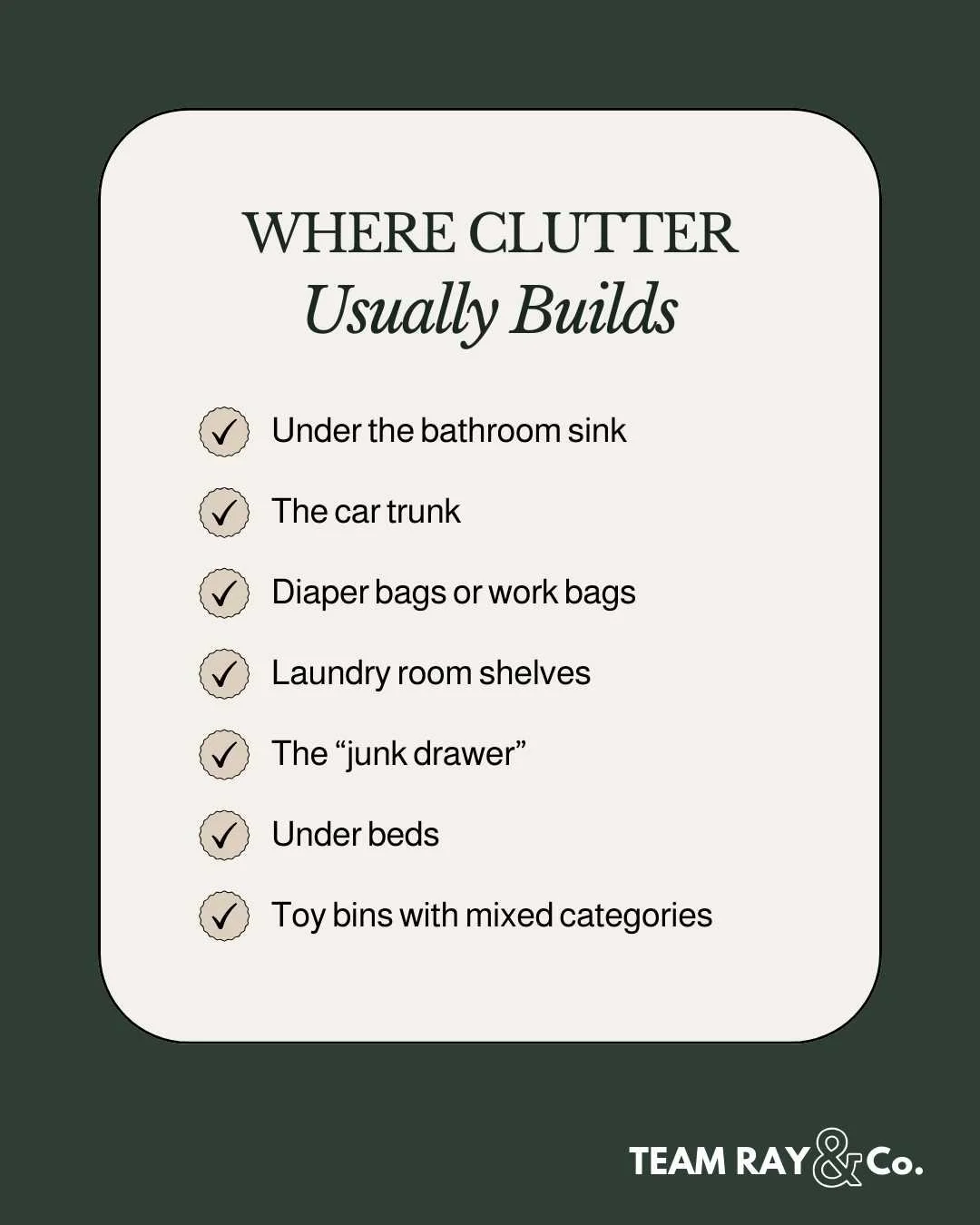
If you’re unsure where to begin, check these common family clutter zones:
Under the bathroom sink
The car trunk
Diaper bags or work bags
Laundry room shelves
The “junk drawer”
Under beds
Toy bins with mixed categories
Clutter hides in places we don’t regularly evaluate. When these spaces accumulate unchecked, they can quietly increase stress, reduce focus, and create a lingering sense of mental heaviness. Spring is the perfect time to gently open those spaces.
You Don’t Have to Finish
This is important.
Decluttering is not a race.
It is not a reflection of your worth.
It is not a measure of how “put together” you are.
Your home serves a living, growing family.
If you clear one drawer this week, that is progress.
If you organize one shelf, that is momentum.
Think seasonally, not urgently.
Making Space for What’s Next
When common areas are lighter:
Mornings feel calmer.
Transitions are smoother.
Cleaning takes less time.
Children focus better.
You feel less overstimulated.
Physical space supports emotional space.
And as spring unfolds, with school events, outdoor play, travel plans, and shifting routines — a simplified home becomes your quiet support system.
Open the windows.
Let the air move through.
Clear one surface.
Rotate one closet.
Fill one donation bag.
You are not trying to create perfection.
You are creating space for your family’s next chapter, gently, steadily, one small area at a time.
And that is more than enough.
