

Making Space for Change Without Forcing It

Why Change Often Feels Uncomfortable
Change is often framed as something to pursue, manage, or master. We are encouraged to improve, adjust, and keep moving forward. Yet most meaningful change does not arrive on command. It usually begins as restlessness, curiosity, or a quiet sense that something no longer fits the life being lived.
Discomfort is often the first signal. Not because something is broken, but because growth requires adjustment. When that discomfort is rushed, ignored, or immediately “fixed,” decisions tend to come from pressure rather than clarity. Allowing discomfort to exist without judgment creates room for more thoughtful change to emerge.
The Role of Space in Meaningful Change
Before change can take shape, space is needed. Space to notice patterns. Space to pause long enough to understand what is shifting. Space to release what has already served its purpose. Without this pause, change often becomes reactive instead of intentional.
Creating space can look simple, even quiet:
Letting go of commitments that feel misaligned
Releasing obligations that drain energy or no longer reflect current priorities creates room for what truly matters.Pausing before making large decisions
Allowing time between awareness and action helps decisions come from understanding rather than urgency.Allowing uncertainty to exist without fixing it
Not every question needs an immediate answer. Sitting with uncertainty often reveals insight that pressure obscures.
This space holds valuable information. It allows clarity to surface naturally, in its own time.
Allowing Change to Take Shape Over Time
Not every shift requires bold action or immediate transformation. Many changes unfold through small, steady adjustments that integrate gently into daily life.
These shifts are often subtle:
A routine that slowly adjusts
Habits evolve as needs change, without requiring a full reset.Priorities that quietly rearrange themselves
What matters becomes clearer through lived experience rather than force.A sense of direction that emerges gradually
Clarity builds through attention and time, not sudden certainty.
These changes may go unnoticed at first, but they tend to feel stable, grounded, and sustainable.
How to Release the Pressure to Have Answers
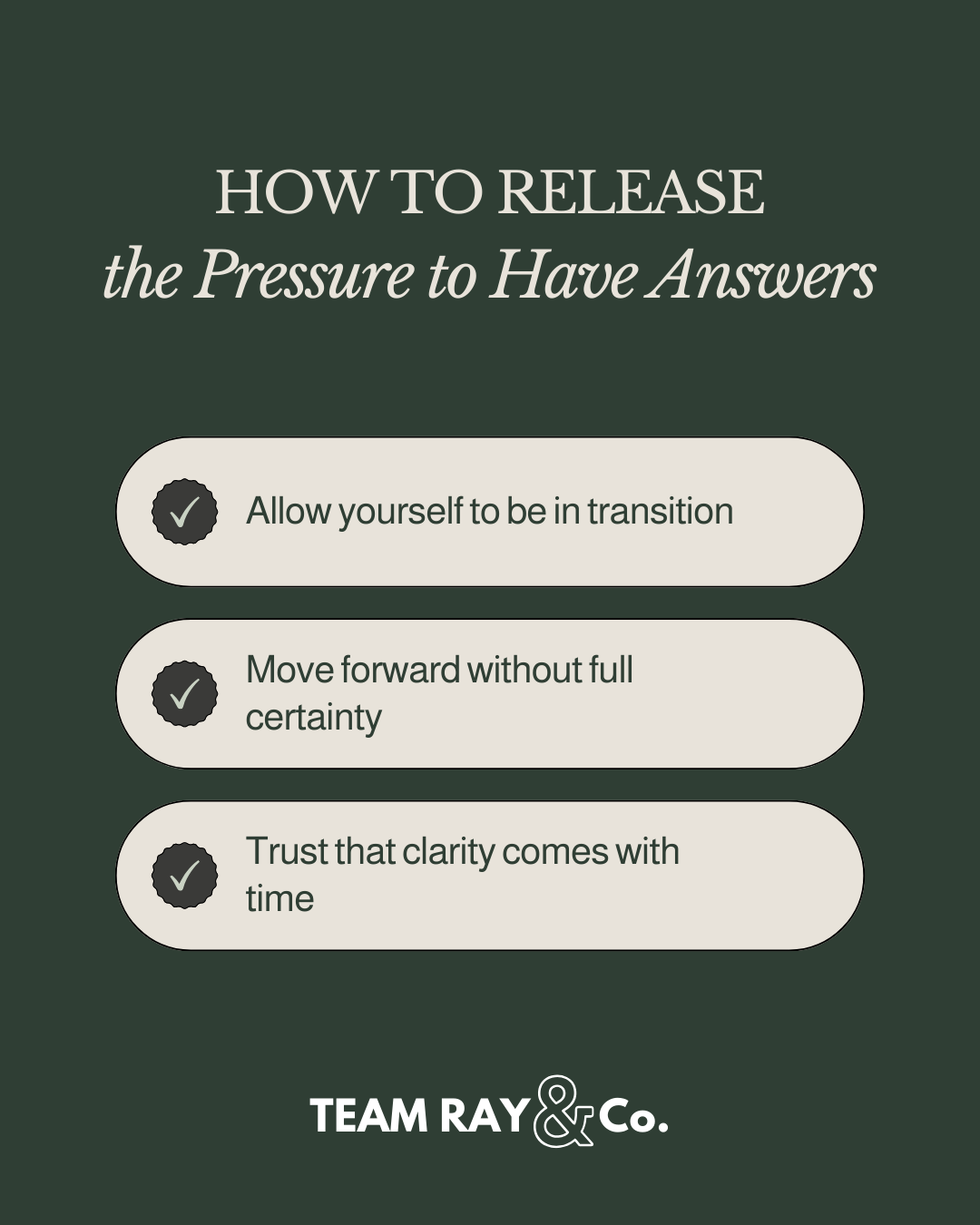
The expectation to know exactly what comes next can make change feel heavier than it needs to be. Clarity is often treated as a requirement for movement, but more often, it emerges through reflection and lived experience. Releasing this pressure is a practice that can be approached in small, intentional ways:
Allow yourself to be in transition without labeling it
Not every phase needs a name or clear definition. Giving yourself permission to simply be in between creates space for insight to develop naturally.Keep moving forward, even with uncertainty
Progress does not require complete confidence. Small, steady steps can coexist with unanswered questions.Trust that understanding unfolds over time
Clarity often arrives after action, not before it. Allowing time to do its work can lead to choices that feel more honest and aligned.
Letting go of the pressure to have answers creates room for decisions that are guided by awareness rather than urgency, supporting change that feels grounded and sustainable.
Supporting Yourself During Transitions
Change becomes more manageable when it is supported rather than resisted. Support can come from routines that provide steadiness, environments that feel safe, and decisions that respect current capacity.
Support may look like:
Simplifying instead of adding more
Reducing complexity creates stability during periods of change.Choosing steadiness over speed
Moving at a pace that feels sustainable allows change to integrate rather than overwhelm.Allowing rest alongside progress
Rest is not a pause from growth, but part of how growth is sustained.
Change does not need to be forced to be meaningful. When space is created and patience is practiced, transitions tend to feel calmer and more intentional. Growth often arrives quietly, shaped by time, attention, and care rather than urgency.
