

Before the Year Begins: What Do You Want More Room For?

Before the year begins, there is value in giving ourselves a little room to look back.
The last few days of the year have a way of making us pause. Maybe it happens while putting away Christmas decorations, sitting quietly after the holiday rush, looking through old photographs, or simply realizing that another year somehow passed much faster than we expected.
We start remembering the people we spent time with, the places we went, the things we celebrated, the difficult conversations, the unexpected phone calls, the projects that worked out, and the ones that didn't.
But a year is made up of more than the milestones we can easily name. It is also made up of ordinary Tuesdays, dinners at home, errands, long conversations, quiet mornings, busy weeks, small disappointments, unexpected kindness, and all the moments we probably didn't think would matter at the time.
Those ordinary moments can tell us just as much about our lives as the big ones.
So before we rush into a new year and start deciding what needs to change, perhaps we can spend a little time simply noticing the year we just lived.
Not judging it. Not grading ourselves on it. Just looking at it with some honesty and kindness.
And then, instead of asking only what we want to accomplish next year, we might ask a quieter question:
What do we want more room for?
More time with people we love. More rest. More creativity. More unhurried mornings. More meaningful conversations. More space to enjoy the things that already make our lives feel like our own.
Sometimes knowing what we want more room for is a better place to begin than deciding everything that needs to change.
Look Back Before You Look Ahead
The new year tends to come with a familiar set of questions: What are your goals? What are your resolutions? What do you want to accomplish? What do you want to change?
There is nothing wrong with having goals. Planning can be useful, and there may be things you genuinely want to accomplish in the year ahead. But sometimes we move so quickly toward the next year that we don't give ourselves enough time to understand the one we are leaving.
What actually happened this year?
Take a moment to think about what filled your life. You don't need to write an essay about it. Even a few honest observations can tell you a lot.
What took most of your time?
What took most of your energy?
Where did your money go?
Who did you spend the most time with?
What kept you busy?
What brought you joy?
What repeatedly made you tired?
What surprised you?
What was worth it?
What wasn't?
Not everything that took a lot of time was necessarily a mistake. Some of the busiest seasons of our lives are busy because something important is happening. A new baby, a move, a family situation, a demanding project, a trip, a renovation, or simply a season when someone we love needed more of us can change the shape of an entire year.
Other things may have filled our lives without giving much back. Looking honestly at both can help us make better choices about what comes next.
A Simple Year-in-Review Tip
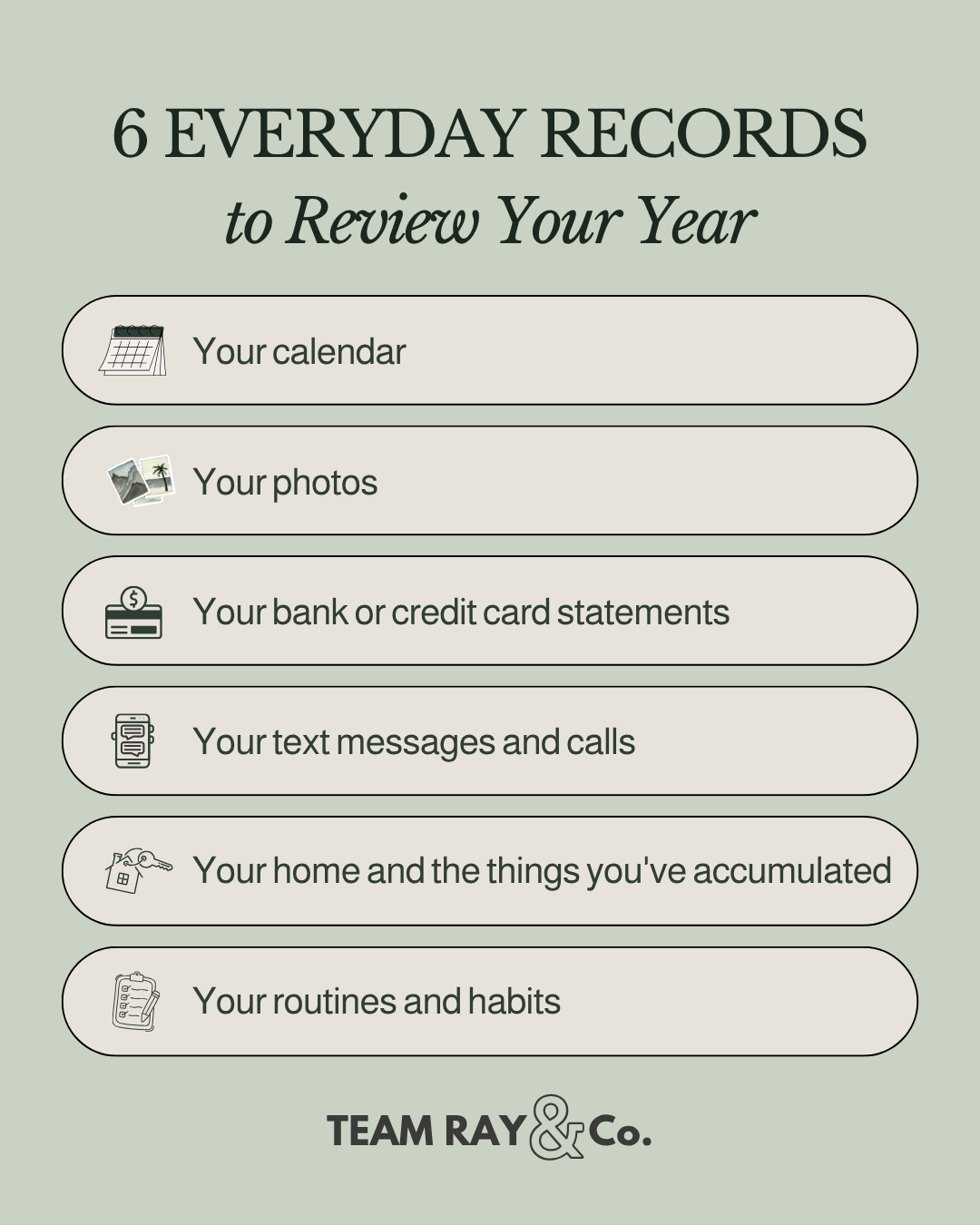
Instead of trying to remember everything, look at a few everyday records of your life:
Your calendar
Your photos
Your bank or credit card statements
Your text messages and calls
Your home and the things you've accumulated
Your routines and habits
You may notice patterns that weren't obvious while you were living through them.
Be Kind to the Person Who Lived This Year
Reflection can easily turn into criticism. We remember the things we didn't finish, the money we wish we'd saved, the plans we abandoned, the habits we didn't maintain, the opportunities we didn't take, and the conversations we wish we'd handled differently.
By the end of the year, it can be tempting to create a list of everything we should have done better.
But we were making decisions all year with the information, energy, circumstances, and capacity we had at the time. Maybe you didn't accomplish everything you wanted because you were tired. Maybe you changed your mind. Maybe your priorities changed. Maybe something unexpected demanded your attention. Maybe you were simply doing the best you could while life was happening around you.
That doesn't mean we shouldn't learn from the year. Reflection should help us notice patterns and make wiser choices. But learning from ourselves is different from being unnecessarily hard on ourselves.
You don't have to enter January disappointed in the person who got you there.
Maybe you can look back and say:
That was a difficult season, and I got through it.
I wish I had handled that differently, and now I know something I didn't know before.
I changed more than I realized.
I did what I could with what I had.
There are things I am proud of that I haven't given myself credit for.
Sometimes that is enough.
A Reflection Tip
When you catch yourself thinking about what you should have done, try replacing the question with:
What did I learn?
What was I carrying at the time?
What would I do differently now?
What did I do well that I haven't acknowledged?
Reflection becomes much more useful when it creates understanding instead of shame.
What Filled Your Life This Year?
Our calendars tell one story about our lives, but so do our homes, bank accounts, phones, and routines.
Look at the year from a few different angles. Think about your time, energy, money, home, relationships, and attention. What do those things tell you about the life you actually lived?
Your calendar might show that you were constantly busy. Your home might show that you accumulated more than you used. Your bank account might reveal expenses that no longer feel important. Your phone might show who you kept in touch with and how much of your free time disappeared into a screen.
None of this is meant to become an audit.
It is simply a way of noticing.
Sometimes we don't realize what our lives have become until we step back far enough to see the pattern.
Look for the Patterns
As you look back, consider:
Where did your time go?
What consistently gave you energy?
What consistently drained you?
What did you spend money on that genuinely improved your life?
What did you accumulate that you rarely use?
Which relationships received your attention?
What kept getting pushed aside?
The goal isn't to judge the answers.
The goal is to understand what your life was actually making room for.
What Do You Want More Room For?
Once you've looked back, a gentler question for the year ahead is not necessarily, What do I need to achieve?
Try asking:
What do I want more room for?
Maybe the answer is more time with your family. Maybe it's more dinners with friends, more mornings without rushing, more weekends at home, more travel, more creativity, more time outside, or more opportunities to simply be present.
Maybe you want more financial breathing room. Maybe you want more space in your calendar. Maybe you want more quiet. Maybe you want more laughter. Maybe you want to spend more time doing something you loved when you were younger but somehow stopped making time for.
There is no right answer, and the answer doesn't have to be impressive.
A meaningful year doesn't necessarily have to be a bigger year. It might simply be a year with more of what matters to you.
You might even write down five things you'd like to have more room for:
More time with people who make life feel meaningful.
More rest without feeling guilty about it.
More experiences that you'll remember years from now.
More financial breathing room and fewer unnecessary obligations.
More time to be present in your actual life instead of always preparing for the next thing.
These aren't resolutions.
They are directions.
A “More Room” Exercise
Complete this sentence five times:
“I want more room in my life for…”
Don't overthink your answers. They might be practical, emotional, relational, financial, creative, or even ordinary.
Sometimes the simplest answers are the most revealing.
Making Room Can Mean Letting Something Go
We often think about making room as an addition. If we want more time with family, we add family activities to the calendar. If we want more exercise, we add workouts. If we want more travel, we start planning trips.
But calendars don't have unlimited space.
Sometimes the only way to make room for something meaningful is to make less room for something else.
That might mean saying no to a commitment you no longer enjoy. It might mean spending less on things that don't matter to you. It might mean letting go of an expectation that has been making life harder than it needs to be.
It could even mean letting go of something you've been holding onto simply because you've always held onto it.
Before adding more to your year, ask yourself what might be worth releasing:
A commitment that no longer fits your life.
A possession you keep out of obligation rather than usefulness or meaning.
A recurring expense that doesn't add enough value.
A habit that consistently takes more than it gives.
An expectation about how your life is supposed to look.
A tradition that has become more stressful than meaningful.
The belief that you have to say yes to everything.
A new year doesn't require us to carry every habit, obligation, possession, tradition, and expectation from the previous one.
Making room can be an act of choosing.
Before You Add Something New
Ask yourself:
What will this require from me?
What will I have less time for if I say yes?
Does this support the life I actually want?
Am I adding something meaningful or simply adding something to my list?
Is there something I need to remove first?
Sometimes making room starts with a simple no.
Let Your Home Tell You Something
Our homes are often excellent records of the lives we have lived.
Look around and you'll find evidence of different versions of yourself. There are probably things you bought for a life you imagined having, things you kept because they belonged to someone you loved, things you used constantly five years ago but rarely touch now, and things that remind you of a trip, a relationship, a hobby, a season of parenting, a career, or a particular chapter of your life.
Our homes accumulate as our lives change.
That isn't necessarily a problem.
But the end of the year can be a useful time to notice whether the home still supports the life you're living now.
Maybe:
The dining table has become a place for paperwork instead of meals.
The guest room has become storage.
The kitchen is organized around the way you used to cook rather than the way you cook today.
The closet is full of clothes for a version of your life that no longer exists.
A room is being used for something completely different from what it was originally intended for.
You don't have to overhaul your entire home in January.
Sometimes one drawer, one closet, one corner, or one room is enough to begin.
The goal isn't to create a perfect house. It is to create a home that makes a little more sense for the life you actually want to live.
A Small Home Reset
Choose just one area and ask:
Do I use this?
Do I need this?
Does this still fit my life?
Does this space support what I want more of?
What could I remove, rearrange, or make easier?
You don't have to declutter the entire house to create a little more breathing room.
Think About the People You Want to Carry Forward
When we look back on a year, we often remember what we did.
But years are also shaped by who was there.
Who made you laugh? Who checked in? Who showed up when things were difficult? Who did you wish you had seen more often? Who did you meet for the first time? Who became part of your everyday life?
And perhaps most importantly:
Who deserves a little more of your attention next year?
Relationships need room too.
Sometimes that room looks like a standing coffee date. Sometimes it is a weekly phone call, a monthly dinner, an invitation to come over, or simply remembering to send a message when someone crosses your mind.
It doesn't have to become another obligation.
Connection can be simple.
As life gets busier, it can be surprisingly easy to assume that the people we love will always understand that we care about them, even when we rarely make time to show it.
The new year can be a good reminder that relationships don't have to be dramatic to be important. A little consistency can go a long way.
Make a Little More Room for Connection
Think about one or two people you would like to be more intentional about staying connected with.
You might:
Schedule a recurring phone call.
Plan a monthly meal together.
Invite someone over for coffee.
Take a regular walk together.
Send a message when you think of them.
Make plans before another month passes.
It doesn't have to be complicated.
Sometimes consistency matters more than grand gestures.
Don't Forget the Ordinary Things
There is a tendency to evaluate a year based on what was remarkable: the big trip, the new job, the move, the wedding, the graduation, the purchase, the milestone.
But most of life isn't made up of milestones.
It is made up of ordinary days.
Making breakfast. Sitting at the kitchen table. Walking the dog. Calling a friend. Grocery shopping. Watching the sunset. Cooking dinner. Folding laundry. Sitting beside someone you love. Having coffee on the porch. Driving home.
Those moments can seem unimportant because they happen so often. Then one day we realize how much of our lives they contained.
Perhaps part of reflecting on the year is appreciating the ordinary things we were fortunate enough to experience again and again:
A familiar home.
A favorite chair.
A person who answered the phone.
A meal we made more times than we can count.
A neighborhood we walked through.
A place where we felt safe.
A routine that gave our days some steadiness.
A small pleasure we almost forgot to notice.
Not every meaningful part of life needs to become a story worth telling.
Some things are valuable simply because they were ours.
A Gratitude Tip
Before moving on to everything you want to change, write down a few ordinary things you hope remain part of your life.
They might be simple:
Morning coffee.
Sunday dinners.
A favorite walking route.
Time with a particular person.
Sitting outside.
Reading before bed.
Cooking at home.
Sometimes the things we want to preserve deserve just as much attention as the things we want to change.
You Don't Have to Become a New Person in January
January can carry a strange expectation that we should all emerge from the first day of the year with a completely redesigned life.
New habits. New goals. New routines. New priorities.
For a few weeks, everything feels possible. Then real life returns. The calendar fills up. Someone gets sick. Work gets busy. A family situation comes up. The weather changes. We get tired. The carefully planned routine becomes harder to maintain.
This doesn't mean we failed.
It means life is still life.
You don't have to become a completely different person because the calendar changed. Maybe the year ahead needs only a few small adjustments.
Go to bed a little earlier.
Spend less time on your phone.
Invite friends over more often.
Take the trip you've been postponing.
Have dinner at the table.
Put some money aside.
Clear the room you've been avoiding.
Call your family.
Take a walk.
Spend more time outside.
Make something.
Rest.
Small choices can change the experience of an entire year.
Give Yourself a Smaller Starting Point
Instead of trying to change everything at once, choose one small action that supports the kind of year you want.
Make the phone call.
Clear the drawer.
Put the date on the calendar.
Take the walk.
Move the money into savings.
Invite someone over.
Small actions count because they are often the ones we can actually sustain.
A Gentler Way to Begin Again
Maybe instead of asking yourself, What should I accomplish next year?, you can ask a few different questions.
What do I want more of?
What do I want less of?
Who do I want to spend more time with?
What deserves my attention?
What no longer deserves as much of it?
What would make home feel better?
Where could I create more breathing room?
What am I ready to let go of?
What would make the year ahead feel like a good life, not simply a productive one?
The answers will be different for everyone.
For one person, it may be a year of adventure. For another, a year of healing and quiet. Someone may want to build something new. Someone else may want to simplify. One person may want a fuller house and another may want a little more solitude.
There is no universal blueprint.
A Simple Way to Choose Your Direction
After answering the questions above, choose:
One thing to make more room for.
One thing to make less room for.
One person to make more room for.
One part of your home to make more functional.
One small action you can take in January.
That's enough to begin.
Before the Year Begins
Before the decorations come down and the calendar turns, give yourself a little time to look around.
Look at your home. Look at your relationships. Look at your calendar. Look at the way you spend your money. Look at the things that filled your days. Look at the things that made those days meaningful.
And be kind to the person who lived through all of it.
You don't need to have everything figured out before January arrives. You don't need a five-year plan. You don't need a perfect list of resolutions. You don't even need to know exactly what the next year will bring.
You can begin with a little awareness.
Keep what mattered. Learn from what didn't. Appreciate what was good. Make peace with what was difficult. Let some things go. Make room for the people, places, experiences, and moments you want more of.
And remember that a new year isn't asking you to become someone else.
It is simply giving you another year to live the life you already have, with a little more intention about what you want that life to hold.
So before the year begins, perhaps don't ask yourself how much more you can accomplish.
Ask yourself what you would like to have more room for.
Then start there.
